Friday, January 30, 2009

Terrible Towels for Superbowl XLIII

It's time for the Superbowl! (Yes, this is a pro-Steelers blog. Sorry Cardinals/Patriots/Browns/etc fans)

In about four hours, the Pittburgh Steelers and Arizona Cardinals will kickoff for this championship game of American football. Fans are cheering on their team or placing bets as to whether the underdog Cardinals will be able to top the boys from Pittsburgh, who will break records to hold the most Superbowl titles in history (6) if they win.

Normally, I don't follow American football closely, at least not during the regular season. (Give me European football any day). However, the Playoffs are a different story. And the Steelers' Playoffs is something different all together.

I can't claim to have ever lived in Pittsburgh, but I'm proud to be part of a large diaspora of Steelers' fans around the globe. This article, recently published by the Times, made me even prouder of my team: The Legacy Behind the Terrible Towels.

One of my biggest complaints about professional sports is the absurd salaries of the players and how it often becomes all about money. But when Myron Cope first suggested the Towel, he didn't envision some grand marketing scheme. Instead, he encouraged the everyday blue-collar workers of his city to just bring out a dish towel or whatever they had to wave and support their team. Even with the success of the golden towel, Cope put the proceeds to good use, donating every cent it earns. What a refreshing reminder, especially during this current recession.

Enjoy this great American holiday of pizza, wings, and the best commercials of the year. May the best team win!

Saturday, January 24, 2009

Book Trailers and More

Since the dawn of the internet, or since internet access became commonplace to the masses, publisher's have been struggling to reinvent their products. Books must now compete with the television, video games, movies, and now the internet as forms of entertainment. Many doomsayers have called the internet the end of the printed book. But publisher's have responded, working hard to integrate web sites and online entertainment with their ink-and-paper products.

Found this essay on The Times today, as a decent introduction to some of the latest initiatives in the publishing industry to "save the book".
See the Web Site, Buy the Book

EDIT: Here's another-- This article, from TIME, illustrates a lot of the ideas that I've been waiting to express and goes even further for some interesting possibilities. Not sure I agree with it all, but here you go. "Books Gone Wild: The Digital Age Reshapes Literature"

Friday, January 16, 2009

Dave Barry's 2008 in Review

Why did I not find this sooner?

Yep, behind the times on this one. But in case you haven't read it yet, check out Dave Barry's annual Year in Review, also known as Bailing Out of 2008.

Enjoy.

Thursday, January 15, 2009

Vienna's Ball Season

Well, it's been a while since I posted and officially a year since I left for Vienna, Austria. However, my reminiscences and reflections on the city won't be abating any time soon, and here's a long post to make up for it.

Christmas is over, the New Year is in full swing, and the Balls have begun in Vienna. Ball Season officially begins each year with the Kaiserball on Dec 31 and continues through the Fasching season until Ash Wednesday. Fasching, known elsewhere as Carnival, is a period of celebration and indulgence before the somber time of Lent. The Carnival celebrations in many cities culminate with the days just before Ash Wednesday, such as Rosenmontag in Köln and Mardi Gras/Fat Tuesday in New Orleans and the Caribbean. Vienna's celebrations stretch through the months of January and February, hosting hundreds of balls, each unique with their special name, dress code, invitees, etc.

The tradition of Ball Season is usually traced back to Austria's beloved Empress Maria Theresa. Famous for her reforms, she observed the wild debauchery during Fasching and resolved that her imperial city would not participate in such vulgarity. She banned the wearing of masks in the streets of Vienna, though she permitted the upper class to have masked parties in their homes. Her son Josef II later extended this privilege to the masses, and masked balls became a popular yearly tradition. This article presents a bit more of a detailed history of the progression to the modern balls (who knew that the waltz was once considered obscene?). Today, very few balls are actually masked, and the waltz is a staple component.

The balls range from elegant celebrations for students and universities to extravagant and exclusive (and expensive!) festivities hosted by specific groups. Many of the balls are open to anyone, provided that you can afford the cost of the ticket (ranging from 20€ to 1000€). Most are held in the Hofburg (the Habsburg's winter palace in the first district), but others are held in the Rathaus or Musikverein. There's the Flower Ball, the Ball of Army Officers, the Pharmacists' Ball, the Russian Ball, and even the Kaffeesiederball (Ball of the Viennese Coffee House Owners). The Rudolfina-Redoute is a masked ball, held on the last Monday of Fasching, whereas dancers attend the Hunter's Ball in Austrian ethnic costume, dirndls and lederhosen galore. The Lawyers' Ball is respected as one of the oldest, always held on the last Saturday, and the Opera Ball (on the last Thursday of Fasching) as one of the most extravagant (complete with televised red carpet gown-critique akin to the Oscars). Here's a full List of the 2009 Balls (pdf), with date, cost, and location.


Nope, there are no mirrors in this room. Those are all chandeliers.

I attended the 2008 Ball der Technik, aka the "TU-Ball", in the Hofburg Palace on the same night as the famous Opernball. (We passed a number of other gowns on the subway, many of whom were headed to Karlsplatz, the central subway stop in front of the Opera). Though the ball was officially sponsored by the Technical University, there were guests of all ages, not necessarily with any direct association to the university. There were at least 50 people from my program, with more than a thousand present over all--all ages, all dancing. I've never seen anything like it.

The main ballroom was mostly devoted to the waltz, with a full orchestra playing much of the night (a small jazz band would relieve them every few hours and play foxtrots and boogie woogies instead). Boothed tables on elevated platforms lined the ballroom's walls for the honored guests. Everyone else had to find their tables in a maze of rooms around the main ballroom--the Habsburgs built a very extensive chain of rooms; they just keep going and going, and there is always another room of tables somewhere ahead. Additionally, there are smaller ballrooms and other dance venues throughout this maze. A swing band was playing in what I like to call the Chandelier Room (above), another jazz band played in an adjoining room further in the maze, and across from the coatroom downstairs there was even a modernized room made to look like a club playing techno and hip hop.

However, before any dancing started in any room, first the debutantes were given the floor. This is an Austrian tradition that is upheld at any ball that you might attend. Young women and men, attending their first ball, prepare for this moment months in advance as they take dance lessons at any number of ballroom schools throughout Wien. On the night of their ball, they don long white gowns and gloves or black tuxedos and enter the ballroom in a polonaise procession. The first dance, a waltz, belongs to these young people. However, the main ballroom is usually packed with onlookers trying to catch a glimpse of this elaborate ceremony, so arrive early and pick a good spot or you will be unable to see or even get into the room--there are thousands of people attending, remember? The picture below, taken shortly after the debutante's waltz, is borrowed from a friend of mine who was able to get into the main ballroom; note all the lovely white gowns. After the debutantes have waltz (and often are congratulated with applause), the dance master calls "Alles Walzer!" and the dance floors are open to everyone. (It was only after this point that I was actually able to make it inside the main ballroom, due to dispersing crowds).


Dancing continues throughout the night, without noticeable pause. Generally, the etiquette is that the gentlemen are expected to ask the ladies to dance, and ladies should not casually decline. However, sometimes an hour is designated "Ladies' Choice", during which the roles are reversed; for this hour, only the women can ask the men for a dance, and the men (if they are indeed gentlemen) should accept. At the TU-Ball, I believe that this hour began at 1am. In order to accommodate a Line of Dance, slower dancers should always stay to the center of the ballroom, while faster couples dance the perimeter in a counter-clockwise direction. Here are some more guidelines for Ball Etiquette.

However, my favorite part of the night was at midnight. With the stroke of 12, the regular dancing stopped and all the guests flooded into the Grand Ballroom for the quadrille. (This time I had advance notice, so I was able to secure a good spot to watch). Dancers line up beside one another, alternating male-female. Each dancer faces his/her partner (who is in the opposite line) with about six feet of space between them. These long rows of dancers stretch from one end of the ballroom to the other.

The orchestra strikes up the chords to the Fledermaus Quadrille, an energetic six-movement piece from Johann Strauss' operetta Die Fledermaus (though usually not all the movements are performed). The steps are complicated, so the Dance Master calls out each step from the stage and demonstrates, such as spinning once with the person to your right, to your left, with your partner across from you, etc. At certain points, couples at the end of the rows dance a galloping dash through the tunnel-like passage between the rows of dancers; but these rows are so long that the dash to the other end takes dancers to the far side of the huge room! During a later movement, I recall some lyrics that everyone shouted in time, but I was unable to make out what was said. This traditional midnight quadrille, a cornerstone of any Viennese ball, is often a situation of laughter, chaos, and just sheer fun.

Immediately after the quadrille, the Galop begins. This country dance also dates to the 19th century. Dancers grab their partners and chassé wildly in a counter-clockwise direction around the room. The dance master will call "Reverse!" and the entire room must quickly change direction. This patterns continues a few times, and then "Tunnel!" is called. Couples form long rows again, and couples on the end (by the orchestra) galop through quickly, most likely laughing the whole time.


Dance Master and helpers demonstrating the quadrille

Shortly after the midnight's break, the orchestra resumed it's waltzes with the most famous of all--Strauss' "Blue Danube". The floor was so crowded for this song that even those that did know how to waltz could not properly move. Yet still, it was an amazing experience--waltzing to "The Blue Danube" in Vienna at an authentic Viennese Ball! It made all the stubbed toes worth it.

Viennese balls do not end until almost dawn; however, a number of the guests left shortly after "The Blue Danube". Sadly, I was among them, due to the need to sleep before an exam the next morning. On the way out, as per tradition, all the ladies were given a Damenspende. This gift for the ladies is like a party favor. It might be a simple piece of jewelry, a waltzing CD, or something similarly small and simple; the TU-ball gifted a baked good, some sort of chocolate gingerbread cake in nice wrappings.

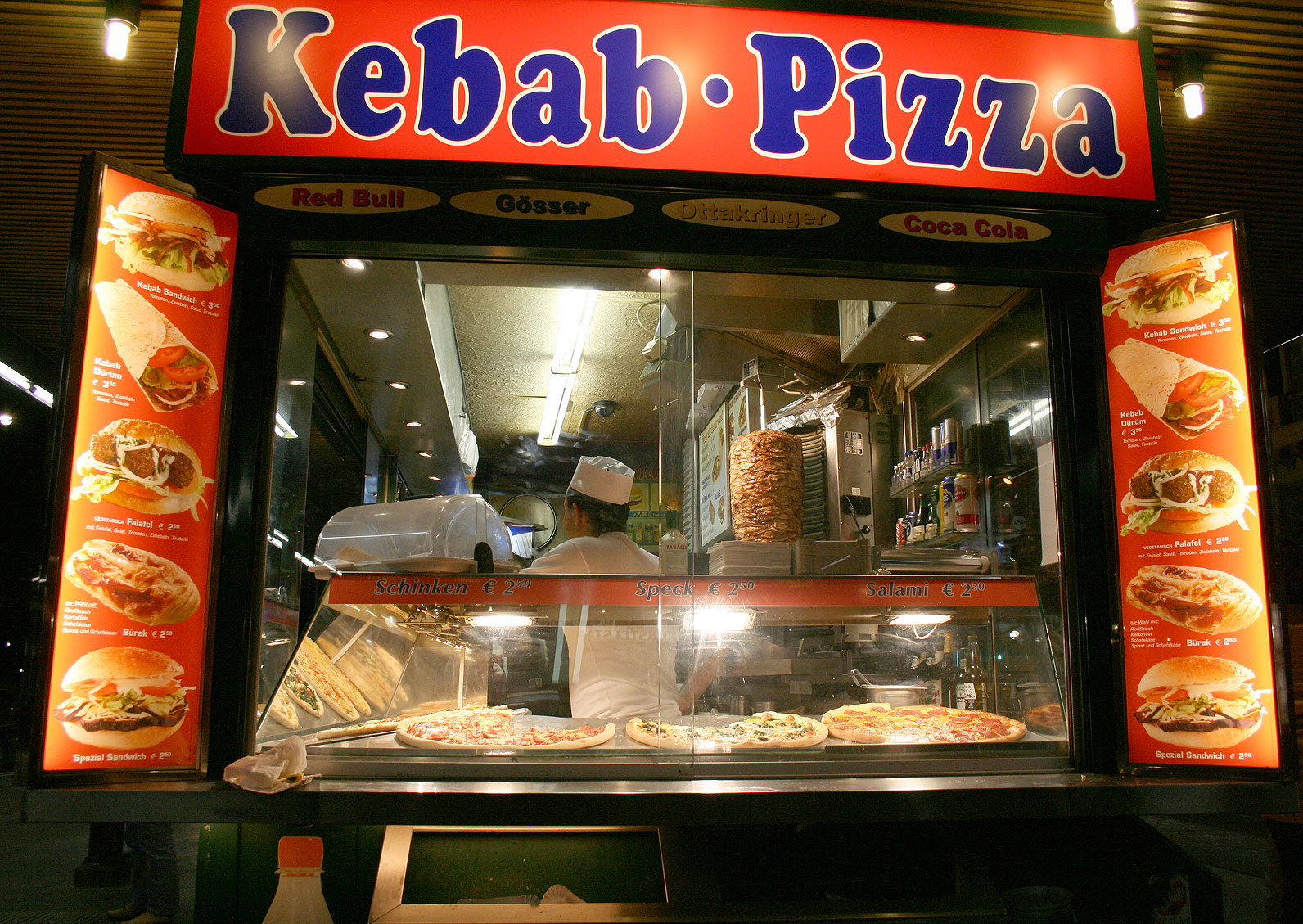
I missed out on only one Viennese Ball tradition (that I am aware of)--the Katerfrühstück, the junk food breakfast afterwards. Most young people dance the night away until the ball ends around 5am; then, walking home in gowns, heels, and tails, they stop for food at the only places that are open--the Imbiss stands. Many of these fast food counters are open 24 hours, providing pizza, kebab, and wurst to any late night (or early morning) wanderer, regardless of their formal garb.

Overall, what an incredible experience. If you are ever in Vienna during January or February, be sure to bring a gown or suit. Here's what the NY Times has to say. I rank the experience of going to an authentic Viennese ball up there with the other grand travel To Do's of Life: See the Taj Mahal. Be in NYC's Times Square for New Years. Go to Rome for Easter. Attend a Ball in Vienna and dance the night away.
Wars with Rockets and with Oil

A couple of interesting articles from today's Times.

Why Israel Can't Make Peace with Hamas: An opinion piece which sheds some light on the complicated relationship between (Sunni) Hamas and (Shia) Hezbollah.

Gas Disputes Run Deeper than Pipes: Detailing the Gazprom tensions between Russia and Ukraine. This piece provides some good background on the weight of the issue for any readers that are less familiar with the situation. It's not really about the gas.

Saturday, December 13, 2008

Technology

I'm ready for DVDs to be outdated technology.

I was kind of sad to see VHSes go back in the day (all of my favorite movies as a kid were on a VHS), but I quickly adjusted to the convenience of a DVD. Multiple DVDs can easily be transported (i.e. in a CD case rather than in their boxes). DVDs can be played by a personal computer, so a DVD player or TV screen was unnecessary.

DVDs have been mainstream for about the past 10 years. However, DVDs are even more fragile that VHSes were. I'm tired of renting a movie only to find that it skips because of a smudge or scratch, and thus I miss some crucial scenes of the film. Or, I hate looking forward to watching a movie that I own, only to take it out of its case and discover that it has a hairline crack and is now completely unreadable. There goes another $15. I guess that's one way to stimulate the economy--just keep making things breakable so that people keep buying.

I'm ready for the next big technological advancement, replacing DVDs with something else. Looks like it might be digitized or iPod movies, such as those sold on iTunes?

Rest in peace, Newsies DVD that I never got to watch.

Thursday, December 4, 2008

Mumbai: Like a Golden Songbird

An interesting article on Mumbai in light of the recent attacks: What They Hate About Mumbai

Saturday, November 22, 2008

Sandmann, lieber Sandmann

The Little Sandman is too adorable and to familiar to German children to not blog about. So here's a quick introduction to das Sandmännchen for German Culture 101.
Das Sandmännchen (the Little Sandman) is a TV show dating back before 1989. Before reunification, there were two competing shows in East and West. Children would watch The Sandman (also known as "Our Little Sandman" or "The Evening's Greeting") before bed as he wished them good night. The Sandman would always appear in a different flying contraption for each show, encouraging themes of technological advancement and an interest in space. His evening greeting makes an appearance in Goodbye, Lenin as the main character watches the show as an adult, after the fall of the Wall.

Wikipedia kindly provides the lyrics to the songs, and the youtube videos are below. Enjoy, and schlaf gut.


Here's a good play of just the title music (no images).

Wednesday, November 12, 2008

Pork and Peaches

Made this recipe tonight. Substituted regular onions for shallots and had no fresh rosemary. Turned out pretty tasty!

Pork Chops with Peaches

Monday, November 10, 2008

Election Reflections from a Student Observer

Well, I neglected to post much of anything during the campaigning season, so here's some reflections back on this incredible election.

Back in 2007, Bush was well out of favor, so a landslide win for the Democrats in 2008 seemed more than likely. At that point, the only one really on the scene was one Hillary Rodham Clinton. It seemed inevitable that we would be progressing from Bush to Clinton to Bush to Clinton. Senator Obama was on the fringes, the newbie with a great talent for speeches, not yet enjoying the familiarity of being a household name as Senator Clinton. To be honest, the first time I remember hearing his name was during all the fuss of the People paparazzi shots of Obama on the beach.

As we approached primary season, suddenly the rising star took off to become a serious contender. Until after Super Tuesday, I really expected that Clinton would clearly dominate or try to dissuade him by asking him to be her VP. But while Mrs. Clinton is certainly qualified, she is a polarizing force. It seems that everyone was starkly divided toward her, with either strong support or intense dislike. In contrast, Obama not only proved himself to be equally talented and qualified, but a uniting force that brings people of many backgrounds together.

Initiate the six-month showdown: Clinton vs. Obama. It was fascinating to be teaching in Austria during this time, and trying to explain to the students what was happening and why it had stretched on so long. I polled the classroom at one point in March, and the majority of the 18-year-olds supported Hillary Clinton (a handful supported Obama and none supported McCain). Yet only a few months later, hundreds of thousands gathered to hear Obama in Berlin and support the presidential candidate.

We all know how it ended. After a bitter season and much division and derision among the Democrats, Obama squeaked by with more votes and was declared the official candidate. We all waited tensely throughout the summer, biting our nails in fear that he might choose Hillary as his VP. Instead, he chose the well-seasoned senator Joe Biden to balance his youth.

Enter the conventions. The Democratic convention was exciting enough, as Obama and Biden began working side-by-side and really seemed to complement each other. But McCain shocked the world with his announcement of the unknown Alaskan Governor Sarah Palin as his running mate.

Someone asked me recently whether Sarah Palin lost the election for the Republicans or whether they were doomed from the start. I tend to lean toward the latter, but we cannot discount the Palin factor. Her selection electrified McCain's campaign; suddenly conservative voters were rallying with enthusiasm in the same way that the liberals flocked to Obama. She was frank, to the point, and fresh; but she was not ready for the media attention or the interviews or the SNL impersonations. (Do not discredit the power of Tina Fey's Sarah Palin! Tina Fey really solidified America's view of Sarah Palin). Her inexperience and novelty status backfired.

After a few tense last weeks (with much name-calling and mud-slinging), crowded flooded the polls. I maintain that the source of these record turn-outs was not McCain or Biden, but the two younger names on the ballot--Obama and Palin. Voters came out in record numbers to show their support for the electrifying factors of each party. In the end, Change and Hope conquered the straight-talk Mavericks. People took to the streets around the country in cities both large and small to celebrate victory, history, and change.

I've brushed over quite a bit, but also consider More Intelligent Life's Entire Election in a Single Graphic for a hilarious summation.


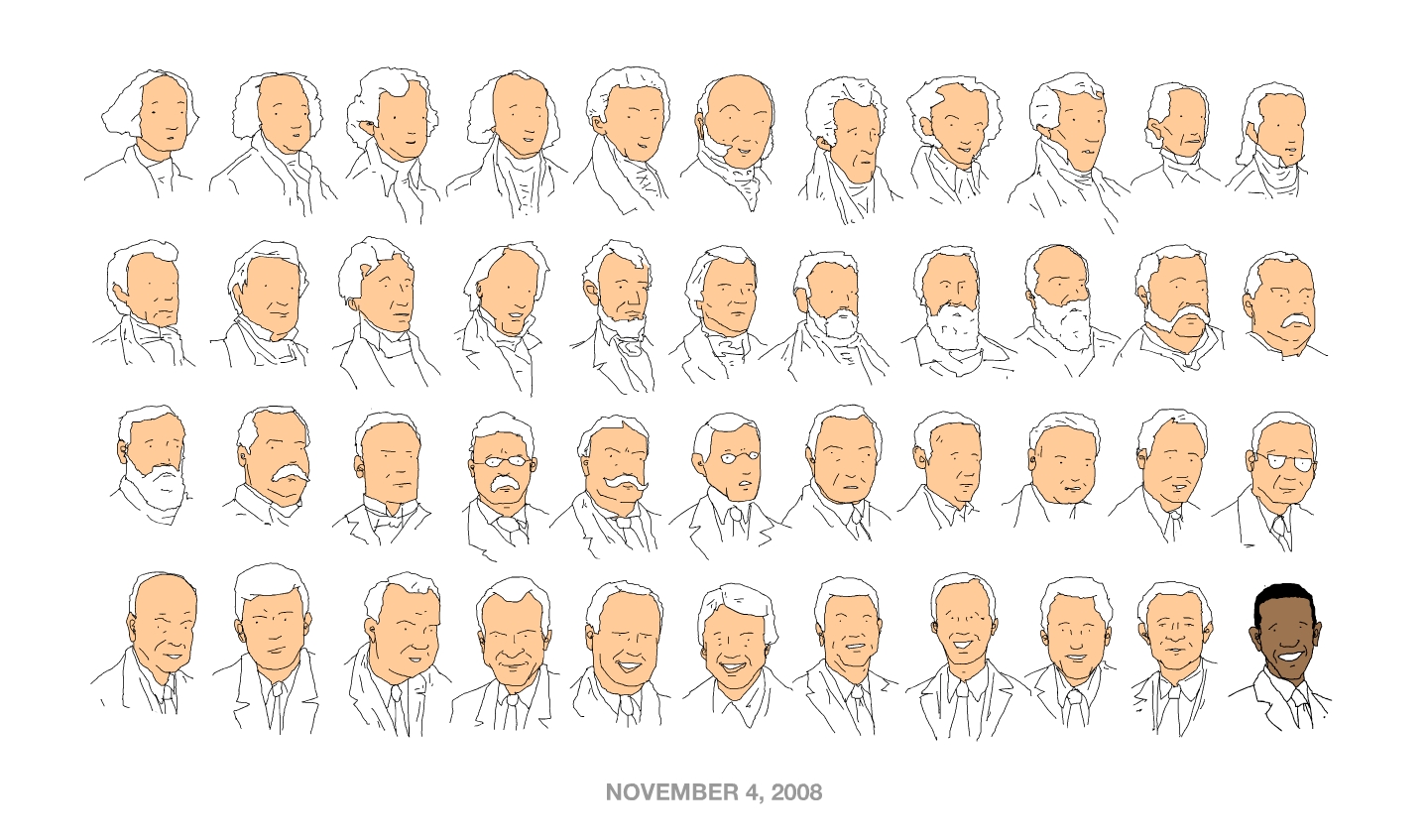
To close, a drawing that's been circulating. I don't want to emphasize the race factor, but it is not something to overlook. Obama will indeed be our first black president, but I would instead like to stress that he is our first non-white president and one of the youngest elected! We have had many excellent leaders in the past, but many have come from similar backgrounds of well-established white upper-class political families (or dynasties). Whereas Obama--with a mother from Kansas and a father from Kenya, born in Hawaii, schooled in Indonesia, educated at Harvard, and working in/with Chicago--not only represents diversity through his skin but through his life story. In many ways, he is the American Dream. We did not elect solely the first black president, but a true American.

Friday, November 7, 2008

Reactions to the Election Abroad

I'm at work, so must keep it short and sweet. Here's an interesting article from an ex-pat living in Wien in response to Obama's election.

Suddenly, it may be cool to be an American again

Tuesday, November 4, 2008

Election Day

It's the big day in America. The first Tuesday of November. The polls are open and the voters are rolling in.

I haven't had the opportunity to express my thoughts about this election here yet, but suffice to say that it has been fascinating. The old methods of campaigning are gone, replacing by campaigning of the internet age. From this idealist's perspective, it seemed that in this election individuals had a say more than ever before. Anyone could start a blog and publish their views, or spread links to YouTube commercials or parodies rapidly through facebook posts. Online ads are everywhere, and even the hip webcomics have endorsed candidates. These individuals have reached the generation of younger voters, the 20-somethings and college students who live daily on the internet. Indeed, over the past few days, over a million facebook users have donated their status to support one candidate or the other.

If you are an American citizen, please get to the polls today. For years we've been slack and little more than half of the American population has exercised their democratic right and privilege. Let's not take it for granted, and let's make our voices heard. Records have registered, and the younger generation is coming out in hordes. Let's make it an election for the history books.

Even Starbucks is making a push by giving out free coffee to anyone who voted.

Friday, October 31, 2008

Seattle

For a long time Seattle and San Francisco have waited at the top of my mental list of West Coast places to visit. I'll get out there one of these days.

The Times features Seattle this weekend.

Thursday, October 23, 2008

Wednesday, October 22, 2008

Jeden Montag ist Schnitzeltag!

On your next trip to Vienna, a few restaurants definitely not to miss. These were my favorites in Wien, and arguably the best (for students at least) in the city.

Side Step Tapas Bar, located near the Rathaus. This was my first experience with tapas, but a place that I will never forget. The food is EXCELLENT, and the servers are very friendly and provide great recommendations.

Zanoni & Zanoni, Vienna's most popular gelateria, is located right near Stephansdom. Zanoni & Zanoni offers countless delicious flavors and other dessert options, and it's open year round. Ask about the Blumentüte ("flower cone")-- 3 scoops ("kugeln") for 2€! (Eissalon am Schwedenplatz is another tasty alternative).

The Cafe Beno. I never made it there myself, but this was a favorite haunt of students. Go for Schnitzeltag!

Der Wiener Deewan, a pay-what-you-want Pakistani restaurant near the university. During the last few weeks when I was practically living at the university library, I ate at the Deewan often and saved a pretty penny! Food is served buffet style, and you pay as you leave. The only set cost is for drinks.

The Centimeter, at various locations throughout the city. Everything is served in HUGE portions, measured out according to the metric scale, from a meter-long wurst to a meter-of-beers to beer that is a meter tall. Go with friends and order their signature dish, the Sword. This is a broadsword skewered with turkey schnitzel and pork, with chili, wings, and fries below. Amazing meal, but it will take many hearty appetites to finish it!

The Cafe der Provinz is located near the Rathaus (and not far from a great Italian place whose name escapes me). This cafe is very relaxed and casual, specializing in cuisine from Provence and crêpes. A great option for a full meal, a cup of coffee, or dessert.

Figlmüller claims to have the largest schnitzel in Vienna. Regardless of whether or not this is true, their food is tasty, the restaurant is conveniently located in the first district, and it's well worth a visit. However, this restaurant is very popular with tourist guidebooks, so there may be a wait.

SalmBrau is probably one of the best micro-breweries in Vienna. It is conveniently located very close to the Belvedere.

Zwölf Apostelkeller models itself as a "Stadtheuriger"--that is, an Austrian wine tavern located within the heart of the city rather than on its outskirts. While Zwölf Apostelkeller cannot replace the true heuriger experience, it is a handy option during the winter months when most heurigen are closed.

The Naschmarkt, is a long outdoor market from the edge of the first district (by the Secession building) into the 5th/6th districts. This market has existed for over 200 years by the "river" Wien (from which the city gets its name); it still has great produce but don't be intimidated by the vendors shouting "Bitte schön, bitte sehr!" Be sure to check out the Döner Kebap and the small specialized restaurant-stalls parallel to the produce stalls; sometimes these are rather pricy, but very tasty. Come back to the Naschmarkt Saturday mornings for an extensive antique and flee market. Also, consider the Brunnenmarkt in the 17th district. And there's an excellent 24-hour Turkish bakery not far from there.


And of course, the Heurigen. I'll write up more on that later.

The Rise and Fall of Empires, as told by Coffee

Stumbled across this old treasure from ages ago. In an amusing and surprising essay, Josef Joffe traces the discovery of quality coffee to the downfall of empires. History in a Hazelnut Shell

"There is a reason why the great empires of yore have gone under when confronted with a Melior full of freshly brewed Kenyan Blue. Either you tend to your gold-plated Gaggia or to your F-16. You don't fight with a frappuchino in hand. And as you admire that gentle dollop of steamed milk in your macchiato, what will you think about: the ''halls of Montezuma'' or the beaches of Cozumel?"


P.S. Despite that it might have caused the fall of the Habsburgs, I could use a good Melange right about now.

Sunday, October 12, 2008

A Budgeted New York Travel Itinerary

Because sometimes it seemed easier to find the cheap spots abroad than in our own American city: The Frugal Traveler takes on NYC

Saturday, October 11, 2008

Two Things

Austrian political front: Freedom party leader Joerg Haider, governor of Carinthia, was killed suddenly in a car accident today. See the full report from BBC. Terrible and very sudden, especially considering his party's success in the recent elections.

And just some numbers for reference on the economy: Consider these numbers from when I was abroad and dealing with the rising exchange rates, and now the current rates-- $1.36 for 1€ or $1.86 for 1 GBP.

Just some specifics in case you were wondering.

Thursday, October 9, 2008

Nobel in Literature

Congratulations to Jean-Marie Gustave Le Clézio, French author and winner of the Nobel Prize! Check out Open Letter's blog Three Percent for more, and be sure to check out the remarkable texts published recently by this new international press.

Sunday, October 5, 2008

For your Amusement: Angry Brits and Prescriptive Grammar

Here are some letters to the editor from the Telegraph. These Brits would be scandalized by the American dialect and our "stubborn refusal" to pronounce that darn middle "h" in "why". Enjoy.

Collapse of the English Language

Disclaimer

The views expressed on these pages are solely belonging to the author and do not reflect the views of the Fulbright Program, the U.S. Department of State or its partner organizations.