First of all, as we can't be neglecting our literary dates,
Happy Bloomsday!
Twenty years ago, June 16 proved to be the second step toward the fall of communism in Eastern Europe. Just
days before in Poland, Solidarity had emerged victorious in the first free, democratic election in all of Eastern Europe. June 16, 1989, was a day of symbolism for Hungary, but this symbolism proved most powerful. On this date, the Hungarians performed a reburial--a reinterment of a man who was once regarded as a traitor, an enemy of the state, and perhaps even Hungary's most potent criminal against communism.
In 1953, the Hungarian Communist Party selected reform-minded
Imre Nagy as their new Prime Minister, but he only lasted two years before falling out of favor. In October 1956, the people called for a change and students discontent with communism, led to the
Hungarian Uprising. Amidst tumult and revolt, the people of Hungary called on Nagy as their revolutionary leader. Indeed, it is hard to understate the significance of the 1956 Hungarian Revolution; not only is it regarded as one of the proudest moments in Hungarian history, but it also marks the
first major revolt against communism and the USSR--indeed, a revolution against the revolution. But in November, Soviet tanks invaded Hungary. Nagy was arrested and, along with other leaders of the revolution, executed and dishonorably interred.
Decades later, the Soviet Union was beginning to weaken, and a more flexible and reform-minded Hungary was passing legislation toward democracy. In May they had removed barbed wire from the borders with Austria, the first step toward opening borders with the West (!), and thus slowly tearing a hole in the Iron Curtain. In this spirit, on June 16 the grave of Nagy and his revolutionary comrades was opened, and they were
honorably buried with pomp and respect. 250,000 people are estimated to have attended his reburial.
The Reinterment of Nagy was just another step away from the USSR and toward democratization. However, historians today consider this symbolic act as the keystone in Hungary's strides toward democracy in 1989; the symbolism became the strongest mark in their break with communism. Like Solidarity's election in Poland, Nagy's reburial marked the rise of a New Europe, encouraging and accelerating revolutionaries in neighboring Czechoslovakia and East Germany.
Some time after Nagy's reinterment, a statue was built to commemorate the leader. He is posed on a bridge, staring wistfully toward the Hungarian Parliament building.
Twenty years after the event of his reinterment, Hungarians celebrated their hero and the change he wrought--both in life and in death.
 Imre Nagy's statue looking toward the Hungarian Parliament (my photo, May 2008)


 Chicken Stuffed with Asparagus, Goat Cheese, and Sundried Tomatoes


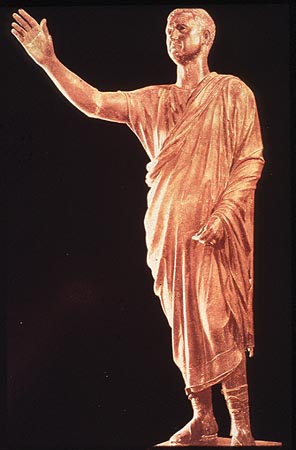 In the age when foreign languages are frequently being cut from school budgets, the argument often arises: What is the value of Latin? What's the point in teaching students a dead language that they will never be able to use?


