Showing posts with label language. Show all posts

Monday, October 31, 2011

Link Dump!

Hodgepodge of links for Halloween:

Breaking news: UNESCO has voted to give Palestine full membership, and the U.S. cuts funding, which consists of about 20% of UNESCO's budget. Here's how the voting panned out.

Eco-friendly: The House of Plastic Bottles in Argentina, giving new life to reduce, reuse, recycle

Current events: Devastating floods in Thailand, called PM Yingluck's Katrina, and the calamity of certain administrations when dealing with natural disasters

Economy: Poland is still holding strong and is turning more to shale gas for increased energy independence

Immigration: 50 years of Multikulti in Germany

Trade: Discontent between U.S. and China, trade relations, and China's devalued currency so that a weaker currency leading to a stronger economy

Divided State: Kosovo's future? But where does the sub-division stop, and how to avoid a Pandora's Box of ethnic tensions? And in a state that has defined itself by the current borders?

Language tools: Linguae Live.ca

Fun: Pie and Prosperity (1902 NYT article)

Saturday, October 2, 2010

Polish Lesson

It's come to my attention that many readers of this blog might know absolutely nothing about Polish. In the interest of encouraging you to visit Poland, here's a very basic lesson to help you get started.

Pronunciation
This may be the hardest part for English-speakers who start learning Polish. Polish has a number of longer words with sounds that might often tongue-tie English-speakers. Here are some VERY basic approximations to help you start reading Polish words. This should not be considered an exact replication of the sounds, it's only meant as a start. (For example, there is a difference between cz and ć, but it's hard to hear when you start learning). I'll try to find audio files as well.

cz = "ch" (like "chalk")
ć or ci = "ch" ("cheek")
sz = "sh" ("shark")
ś or si = "sh" ("sheep")
drz or dż or dzi or dź = roughly "j", but best to listen to audio of the different z's (z, ż, ź) to hear the difference
rz = "rj" (similar to a strong rolled r; BBC compares it to the "s" in "treasure")
c = "s" or "ts" (NOT /k/)
j = "y" (i.e. Jakub is pronounced more like "Yakub")
ń = nasal "n"
ł = "w"
w = "v"
ą = "on" (think French)
ę = "ehn" (like French "bien")
ó = "oo"


Now that you've mastered many of the basic sounds, take a look at this chart from the BBC. They do a more precise job at explaining some of the sounds, and they also include helpful phrases. For those of you who might know the IPA or just want more info about the history of the Polish language, here's the Wikipedia link with phonology and orthography.

EDIT: And because BBC continues to be amazing, here's their link for audio files to pronounce the Polish alphabet.

Powodzenia! (Good luck!)

Thursday, September 9, 2010

Words for Family

Here's an interesting discussion about language and how different languages express familial relations. (For example, in Spanish concuñado is "the brother of the spouse of my sibling" (my brother-in-law's brother?), easily expressing the connection without having to worry about such a mouthful).

English seems quite bland and simplistic in comparison to some of the examples given. I recently also learned about Bininj gun-wok, an indigenous Australian language, which has a collection of familial terminology so complex that it can take more than 20 years for native speakers to fully acquire them all!

Wednesday, August 18, 2010

Wrapping things up

It's hard to believe, but I've already reached the final days of my Polish language training. I can't claim to be fluent in Polish (no where near!), but I do feel more comfortable with the language after these three weeks. Though the real test begins next week, when I won't have the structure of a summer program to support my language learning.

Polish summer courses are fairly popular with students across Europe and across the world. The most famous is the program at Jagiellonian in Kraków, which some semesters enrolls hundreds of students of all ages and nationalities. Smaller programs, like that in Poznań, also exist, as well as at certain universities and in major cities in the U.S. (for example, Washington, D.C.).

Wednesday, August 4, 2010

Notes from PL: Things I Have Learned So Far

As part of a summer language program, I've been gradually learning more about Polish, Poznań, and the local culture. I am the only American enrolled in the program and while English is the language of instruction, I am one of the few native-English speakers. (I've had a lot of fascinating conversations that involved explaining colloquial phrases in English--why do we sometimes address small children as "pumpkin" anyway?-- and learning about similar phrases in German, such as "Mäuschen" and "yaco taco" (not sure about the spelling there...)). Here's some things I've noticed so far:

-"Googlować" is a verb in Polish (also "googlen" auf deustch). So is "facebookować".

-There are only three reasons to learn Polish: 1) For your studies, 2) To reconnect with family or distant Polish roots, or 3) (the most popular reason by far) your boyfriend/girlfriend is Polish.

-Poznań's football team is currently the best in Poland. But they still lost to Praha tonight. (Also, their nickname is "Kolejorz", which roughly translates to railroad workers).

-Poznań's stadium is currently the best stadium for the EuroCup 2012 (but that's because it's the only one that is completed). I believe tonight's match (loss) was the first game in that stadium.

-A (traditional) Polish lunch is HUGE. We're talking soup, meat, potatoes, salad, and vegetables required at each meal with lots of other side dishes to complement. However, dinner/supper is basically the same thing as breakfast (breads, cheeses, lunchmeats, tea), so be sure to eat up.

-Poznań is also famous for its rogale swietomarcinki, or St. Martin's croissants. They're traditionally eaten on Nov. 11, but bakers now often carry them year round. (I can't testify if this recipe is accurate, but it's a good image).

-Like much of the rest of Europe, about 90% of the city center of Poznań was destroyed during World War II. (Poznań was actually part of Prussia for a century, and there was much debate when drafting the Treaty of Versailles if it would be included in the newly resurrected Poland or not). The majority of the buildings were rebuilt using detailed replicas, but the decorative city hall (which is not actually a city hall) located in the center of the Stary Rynek, or old marketplace, was not rebuilt until 1999. During communist times, such a ornate building was not considered necessary.

Monday, October 5, 2009

Simple Instructions

For the wanderers, the children-at-heart, and those who simply desire straightforward instructions to a complicated world: "Instructions" by Neil Gaiman, which will be published with illustrations in the near future. Unfortunately, I do not have any pictures to share of his book signing yesterday, as the auditorium was so full that the security guards would not allow me to enter. Ah, the curse of always running late.

So instead, an image of a word for all those restless wanderers and linguistic geeks out there (courtesy of C):

Monday, June 8, 2009

Praise for Latin

In the age when foreign languages are frequently being cut from school budgets, the argument often arises: What is the value of Latin? What's the point in teaching students a dead language that they will never be able to use?

In high school, I remember many academically-ambitious students solely choosing to study Latin as a means to improve their SAT scores. According to their argument, the study of Latin would make them more aware of the etymology behind word roots, and thus they would have a distinct advantage in the vocabulary section--even if they did not know the word, they could recognize the Latin roots to guess its meaning.

Though this may be true, students of French, Spanish, or German might not be far behind thanks to all the cognates and crossovers between the languages. However, I firmly believe that Latin has a much more meaningful value beyond improving test scores.

Unfortunately, I have not yet had the opportunity to learn Latin myself, but I am familiar with some of the cases and I am very aware of the disciplined work required of any Classics major and the complex struggle to create a short translation. The Guardian recently reported the reinstation of Latin by many British schools and offered Charlotte Higgins' view to praise its value. Latin not only teaches word roots and etymology, but it teaches discipline, grammar, and structure. Thus, Latin is not only relevant when learning another foreign language (and may be especially useful when learning a language with cases, like German), but it improves our understanding of the prescriptive rules of "proper" grammar in our own native English. Harry Mount most eloquently puts it in his masterful "Vote for Latin" from 2007.

In Vienna, I taught at a Gymnasium (high school equivalent) and worked with students who were learning English. For most students, English was just one of many languages that they were studying. Early in their studies (I believe around age 10), the students would select to study either English or Russian as their specialty and continue this study intensely at least until graduation (and the Matura exams) at age 18. Around age 12, all students started learning another language: Latin. From there students could continue by starting French, picking up the other specialty language (English/Russian), and taking electives in Spanish or Italian. Competency in multiple languages was crucial for an Austrian student, given the country's central position in Europe bordering so many different language groups. Thus, instruction with Latin is essential and provides the disciplined foundation for all future language learning and made learning the Romance languages much easier. (Indeed, older students would ask for Latin, rather than German, translations of English words in order to more fully understand the meaning).

In America, we're not surrounded by so many different languages, and thus our education's focus is not on foreign languages and certainly not on Latin. Don't get me wrong, I know that there are other important things to study and the mastery of any foreign language is very difficult. But I think we suffer because of our lack of respect for languages in education. We even blindly declare the dead language to be "useless". But Latin is not just a language for monuments, but a tongue for intellectualism and deeper thought, for instruction and comprehension, for developing discipline and devotion.

Friday, March 20, 2009

Tonight, Esta Noche

The bi-lingual revival of West Side Story opened tonight. The Jets will retain many of their famous songs, but the Sharks will now be singing their same songs in their native tongue--Spanish. The NYT offered this interesting review of the show.


"The gangs in “West Side Story” shocked in 1957. Brooks Atkinson in The New York Times called their conduct “neurotic and savage,” with a code “rooted in ignorance and evil.” While writing the original book, Mr. Laurents said, he at times feared they would be too unsympathetic. Now he worried about the opposite problem: that those “savages” seemed too much like benign, lovable misfits... Because “West Side Story” deals with social change, previous revivals have been burdened with a comparison between what was happening onstage and what was happening on the street, and critics have complained that revivals have seemed dated."

Yet this revival is daring, offering a fresh perspective by really allowing language to distance the gangs for the first time, unsettling or perhaps touching closer to home for the audience. I'm fascinated and I can't wait to see it.

EDIT: The Times also now has this front-page review up. Enjoy!

Friday, March 6, 2009

It's all Chinese to me!

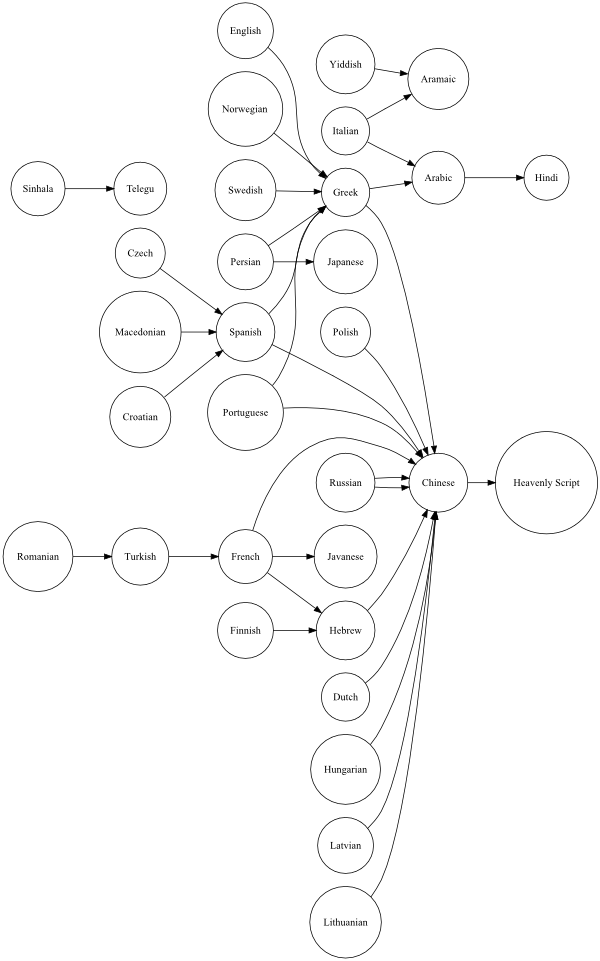
Language Log has put together this very interesting chart of incomprehensible languages. In English, our idiom references Greek as the stereotypical incomprehensible language, but many other languages might say it sounds like Hebrew, like Chinese, or even like Spanish.

Check it out: The directed graph of stereotypical incomprehensibility

(Thanks, Steve!)

Sunday, February 22, 2009

Sunday procrastinations

Thought this was appropriate for a Sunday afternoon, as students around the country struggle through piles of assignments, papers, and homework for the upcoming week. A friend provided this link, and the tune is so catchy that I couldn't help sharing.

I don't want to work either.

Sunday, October 5, 2008

For your Amusement: Angry Brits and Prescriptive Grammar

Here are some letters to the editor from the Telegraph. These Brits would be scandalized by the American dialect and our "stubborn refusal" to pronounce that darn middle "h" in "why". Enjoy.

Collapse of the English Language

Wednesday, June 18, 2008

Cycle of Intimidation: Learning a Foreign Language

I need to learn to not be intimidated by every foreign language I am learning.

First it was French. Though I flourished in the high school classroom, I winced at the thought of trying to use (or understand!) Français in the world beyond those four walls. Though I didn't realize it at the time, looking back I realize that I really was in it more for the grade and for friends than for the language. I learned what I was required to learn and did well, but never pushed myself beyond that. Thus, I flopped when I got to college.

Then there was American Sign Language. A beautiful language. After taking a class every semester for the past five semesters, I'm happy to say that by last fall, I was competent--terrible, but competent. If I was given a specific topic (naming countries, telling a practiced story, etc), I passed with flying colors. But I had no social skills for day-to-day events. I gave up going to the weekly Silent Coffee nights (ASL students' social gathering), and after a semester abroad with no practice I fear that I have the little that I had. I can no longer take ASL classes, so my only option is attempting to socialize using only ASL.

Finally, I began German. It's strange that this is the language I've studied the least, and yet I am the most comfortable with it. In Wien, everyday Deutsch became second nature to me. I never had the courage to speak German with a native speaker who knew that I spoke English, but I loved hearing it around me always. I loved speaking it with friends and the Deutsch-isms that worked into our daily speech. At home, I missed the sounds of that language, and I was sick of hearing only English all the time. Now in the City, I hear Deutsch frequently once more, as many students from Germany live in my apartment. However, here I face a conflict of interest: every time I encounter a German girl-- as I brush by her or as she holds a door for me, for example-- I am caught between an "Excuse me" and an "Entschuldigung", a "Danke" and a "Thank you". And thus, the words become twisted in each other and caught in my throat, and I become the rude, ugly American and say nothing.

I hate that after five months in Österrecih, I still do not have the guts to offer a simple courtesy word to a native speaker who knows that I am American.

Feedback or advice is always welcome. And to conclude this language post, here is an old video that remains one of my favorite ASL vids:


Browse YouTube for other amazing ASL vids. Also, check out Scnappi and my German music post if you haven't already.

Friday, February 15, 2008

On Language

NOTE: Photobucket has been updated, including all the Deutschland pictures! :)

Today it snowed for the first time since I've been in Vienna. Nothing stayed on the ground, but it was beautiful. Reminded me, albeit briefly, of the snows up upstate New York. :)

The more I learn German, the more my French slips further away. (Well, with the exception of sometimes reading cooking directions in French because I still understand more of it written than Deutsch). However, French is a subtle language, and has found ways of sneaking into my subconscious and slipping out of my mouth hidden amidst German phrases. When I first started this language, I had a hard enough time picking up "aber" and not saying "mais". But recently it seems to have gotten worse. I have been saying "quelquefois" and unable to remember "manchmal", and yesterday I asked for olives that were "vert", not "grün". I got a strange look from the vendor, but didn't realize what I had said until my friend told me later. How embarrassing! It doesn't help that there are a good number of German words from French too. (For instance, Austrians call french fries "pommes", short for the french word for potatoes). Dear French, you're a beautiful language, but please stay in your place and wait your turn and stop confusing me!

In other news, here's another sad story about the death of a language. The gifts of the modern age are many; we have the technology to connect everyday individuals around the globe in a way that no one ever dreamed of that a few centuries ago! We're no longer isolated in small villages or remote areas where people might speak a unique language, but as the world shrinks, the smaller languages of the world are decaying and dying off. It's natural that a language will grow and change, mixing with other languages and eventually passing on its legacy and dying out... but nowadays our languages are condensing, and the smaller unique tongues are not passing on any traits to successive generations, but simply reaching a dead end with no heirs. I wish I had more talent with languages to at least listen to some of the tongues that will never be spoken again, but I suppose the continued language decay is inevitable at this point. Terribly depressing.

Disclaimer

The views expressed on these pages are solely belonging to the author and do not reflect the views of the Fulbright Program, the U.S. Department of State or its partner organizations.