Showing posts with label Vienna. Show all posts

Thursday, June 3, 2010

Frugal Travelers

NYT Frugal Traveler Matt Gross has passed the baton to a new FT, Seth Kugel. Kugel will be traveling across South America on a tight budget this summer.

One of Gross' final columns was regarding a journey from Vienna to Budapest by foot. The Danube hike sounds beautiful, though walk steadily for so many days can take its toll. In Vienna proper, the NYT today is highlighting the resurgence of the Karmeliterviertel and Jewish life.

Thursday, July 30, 2009

Gelato Dreamland

Last night I dreamed about Zanoni & Zanoni. Such a wonderful place, and right in the heart of Wien near Stephansplatz. So many delicious flavors of gelato, all needing sampled!

I especially miss the 2€ Blumentüte, a giant "flower cone" which could hold three scoops/flavors of different gelato. In other words, it's a student's dream. I have yet to find any gelato in America that can begin to compare.

Monday, May 4, 2009

The Most Livable City in the World

Just this past week, Mercer officially granted Vienna the title of 2009 Best Quality of Living, passing Zurich from last year... in other words, Wien is *the* BEST city in the world in which to live! (More details of the study here).

Of course, anyone who has lived in this beautiful imperial city could tell you that. ^_^ To celebrate, here's a smattering of my photos of this "very livable" city:

Stephansdom and centercity Wien

one of Otto Wagner's old railway entrances

yellow

stadium

Naschmarkt2

strawberries

Wednesday, February 25, 2009

Neubau

The NY Times takes on Wien's hip and trendy seventh district: Vienna's Neu-Wave Corner

Thursday, January 15, 2009

Vienna's Ball Season

Well, it's been a while since I posted and officially a year since I left for Vienna, Austria. However, my reminiscences and reflections on the city won't be abating any time soon, and here's a long post to make up for it.

Christmas is over, the New Year is in full swing, and the Balls have begun in Vienna. Ball Season officially begins each year with the Kaiserball on Dec 31 and continues through the Fasching season until Ash Wednesday. Fasching, known elsewhere as Carnival, is a period of celebration and indulgence before the somber time of Lent. The Carnival celebrations in many cities culminate with the days just before Ash Wednesday, such as Rosenmontag in Köln and Mardi Gras/Fat Tuesday in New Orleans and the Caribbean. Vienna's celebrations stretch through the months of January and February, hosting hundreds of balls, each unique with their special name, dress code, invitees, etc.

The tradition of Ball Season is usually traced back to Austria's beloved Empress Maria Theresa. Famous for her reforms, she observed the wild debauchery during Fasching and resolved that her imperial city would not participate in such vulgarity. She banned the wearing of masks in the streets of Vienna, though she permitted the upper class to have masked parties in their homes. Her son Josef II later extended this privilege to the masses, and masked balls became a popular yearly tradition. This article presents a bit more of a detailed history of the progression to the modern balls (who knew that the waltz was once considered obscene?). Today, very few balls are actually masked, and the waltz is a staple component.

The balls range from elegant celebrations for students and universities to extravagant and exclusive (and expensive!) festivities hosted by specific groups. Many of the balls are open to anyone, provided that you can afford the cost of the ticket (ranging from 20€ to 1000€). Most are held in the Hofburg (the Habsburg's winter palace in the first district), but others are held in the Rathaus or Musikverein. There's the Flower Ball, the Ball of Army Officers, the Pharmacists' Ball, the Russian Ball, and even the Kaffeesiederball (Ball of the Viennese Coffee House Owners). The Rudolfina-Redoute is a masked ball, held on the last Monday of Fasching, whereas dancers attend the Hunter's Ball in Austrian ethnic costume, dirndls and lederhosen galore. The Lawyers' Ball is respected as one of the oldest, always held on the last Saturday, and the Opera Ball (on the last Thursday of Fasching) as one of the most extravagant (complete with televised red carpet gown-critique akin to the Oscars). Here's a full List of the 2009 Balls (pdf), with date, cost, and location.


Nope, there are no mirrors in this room. Those are all chandeliers.

I attended the 2008 Ball der Technik, aka the "TU-Ball", in the Hofburg Palace on the same night as the famous Opernball. (We passed a number of other gowns on the subway, many of whom were headed to Karlsplatz, the central subway stop in front of the Opera). Though the ball was officially sponsored by the Technical University, there were guests of all ages, not necessarily with any direct association to the university. There were at least 50 people from my program, with more than a thousand present over all--all ages, all dancing. I've never seen anything like it.

The main ballroom was mostly devoted to the waltz, with a full orchestra playing much of the night (a small jazz band would relieve them every few hours and play foxtrots and boogie woogies instead). Boothed tables on elevated platforms lined the ballroom's walls for the honored guests. Everyone else had to find their tables in a maze of rooms around the main ballroom--the Habsburgs built a very extensive chain of rooms; they just keep going and going, and there is always another room of tables somewhere ahead. Additionally, there are smaller ballrooms and other dance venues throughout this maze. A swing band was playing in what I like to call the Chandelier Room (above), another jazz band played in an adjoining room further in the maze, and across from the coatroom downstairs there was even a modernized room made to look like a club playing techno and hip hop.

However, before any dancing started in any room, first the debutantes were given the floor. This is an Austrian tradition that is upheld at any ball that you might attend. Young women and men, attending their first ball, prepare for this moment months in advance as they take dance lessons at any number of ballroom schools throughout Wien. On the night of their ball, they don long white gowns and gloves or black tuxedos and enter the ballroom in a polonaise procession. The first dance, a waltz, belongs to these young people. However, the main ballroom is usually packed with onlookers trying to catch a glimpse of this elaborate ceremony, so arrive early and pick a good spot or you will be unable to see or even get into the room--there are thousands of people attending, remember? The picture below, taken shortly after the debutante's waltz, is borrowed from a friend of mine who was able to get into the main ballroom; note all the lovely white gowns. After the debutantes have waltz (and often are congratulated with applause), the dance master calls "Alles Walzer!" and the dance floors are open to everyone. (It was only after this point that I was actually able to make it inside the main ballroom, due to dispersing crowds).


Dancing continues throughout the night, without noticeable pause. Generally, the etiquette is that the gentlemen are expected to ask the ladies to dance, and ladies should not casually decline. However, sometimes an hour is designated "Ladies' Choice", during which the roles are reversed; for this hour, only the women can ask the men for a dance, and the men (if they are indeed gentlemen) should accept. At the TU-Ball, I believe that this hour began at 1am. In order to accommodate a Line of Dance, slower dancers should always stay to the center of the ballroom, while faster couples dance the perimeter in a counter-clockwise direction. Here are some more guidelines for Ball Etiquette.

However, my favorite part of the night was at midnight. With the stroke of 12, the regular dancing stopped and all the guests flooded into the Grand Ballroom for the quadrille. (This time I had advance notice, so I was able to secure a good spot to watch). Dancers line up beside one another, alternating male-female. Each dancer faces his/her partner (who is in the opposite line) with about six feet of space between them. These long rows of dancers stretch from one end of the ballroom to the other.

The orchestra strikes up the chords to the Fledermaus Quadrille, an energetic six-movement piece from Johann Strauss' operetta Die Fledermaus (though usually not all the movements are performed). The steps are complicated, so the Dance Master calls out each step from the stage and demonstrates, such as spinning once with the person to your right, to your left, with your partner across from you, etc. At certain points, couples at the end of the rows dance a galloping dash through the tunnel-like passage between the rows of dancers; but these rows are so long that the dash to the other end takes dancers to the far side of the huge room! During a later movement, I recall some lyrics that everyone shouted in time, but I was unable to make out what was said. This traditional midnight quadrille, a cornerstone of any Viennese ball, is often a situation of laughter, chaos, and just sheer fun.

Immediately after the quadrille, the Galop begins. This country dance also dates to the 19th century. Dancers grab their partners and chassé wildly in a counter-clockwise direction around the room. The dance master will call "Reverse!" and the entire room must quickly change direction. This patterns continues a few times, and then "Tunnel!" is called. Couples form long rows again, and couples on the end (by the orchestra) galop through quickly, most likely laughing the whole time.


Dance Master and helpers demonstrating the quadrille

Shortly after the midnight's break, the orchestra resumed it's waltzes with the most famous of all--Strauss' "Blue Danube". The floor was so crowded for this song that even those that did know how to waltz could not properly move. Yet still, it was an amazing experience--waltzing to "The Blue Danube" in Vienna at an authentic Viennese Ball! It made all the stubbed toes worth it.

Viennese balls do not end until almost dawn; however, a number of the guests left shortly after "The Blue Danube". Sadly, I was among them, due to the need to sleep before an exam the next morning. On the way out, as per tradition, all the ladies were given a Damenspende. This gift for the ladies is like a party favor. It might be a simple piece of jewelry, a waltzing CD, or something similarly small and simple; the TU-ball gifted a baked good, some sort of chocolate gingerbread cake in nice wrappings.

I missed out on only one Viennese Ball tradition (that I am aware of)--the Katerfrühstück, the junk food breakfast afterwards. Most young people dance the night away until the ball ends around 5am; then, walking home in gowns, heels, and tails, they stop for food at the only places that are open--the Imbiss stands. Many of these fast food counters are open 24 hours, providing pizza, kebab, and wurst to any late night (or early morning) wanderer, regardless of their formal garb.

Overall, what an incredible experience. If you are ever in Vienna during January or February, be sure to bring a gown or suit. Here's what the NY Times has to say. I rank the experience of going to an authentic Viennese ball up there with the other grand travel To Do's of Life: See the Taj Mahal. Be in NYC's Times Square for New Years. Go to Rome for Easter. Attend a Ball in Vienna and dance the night away.

Friday, November 7, 2008

Reactions to the Election Abroad

I'm at work, so must keep it short and sweet. Here's an interesting article from an ex-pat living in Wien in response to Obama's election.

Suddenly, it may be cool to be an American again

Wednesday, October 22, 2008

Jeden Montag ist Schnitzeltag!

On your next trip to Vienna, a few restaurants definitely not to miss. These were my favorites in Wien, and arguably the best (for students at least) in the city.

Side Step Tapas Bar, located near the Rathaus. This was my first experience with tapas, but a place that I will never forget. The food is EXCELLENT, and the servers are very friendly and provide great recommendations.

Zanoni & Zanoni, Vienna's most popular gelateria, is located right near Stephansdom. Zanoni & Zanoni offers countless delicious flavors and other dessert options, and it's open year round. Ask about the Blumentüte ("flower cone")-- 3 scoops ("kugeln") for 2€! (Eissalon am Schwedenplatz is another tasty alternative).

The Cafe Beno. I never made it there myself, but this was a favorite haunt of students. Go for Schnitzeltag!

Der Wiener Deewan, a pay-what-you-want Pakistani restaurant near the university. During the last few weeks when I was practically living at the university library, I ate at the Deewan often and saved a pretty penny! Food is served buffet style, and you pay as you leave. The only set cost is for drinks.

The Centimeter, at various locations throughout the city. Everything is served in HUGE portions, measured out according to the metric scale, from a meter-long wurst to a meter-of-beers to beer that is a meter tall. Go with friends and order their signature dish, the Sword. This is a broadsword skewered with turkey schnitzel and pork, with chili, wings, and fries below. Amazing meal, but it will take many hearty appetites to finish it!

The Cafe der Provinz is located near the Rathaus (and not far from a great Italian place whose name escapes me). This cafe is very relaxed and casual, specializing in cuisine from Provence and crêpes. A great option for a full meal, a cup of coffee, or dessert.

Figlmüller claims to have the largest schnitzel in Vienna. Regardless of whether or not this is true, their food is tasty, the restaurant is conveniently located in the first district, and it's well worth a visit. However, this restaurant is very popular with tourist guidebooks, so there may be a wait.

SalmBrau is probably one of the best micro-breweries in Vienna. It is conveniently located very close to the Belvedere.

Zwölf Apostelkeller models itself as a "Stadtheuriger"--that is, an Austrian wine tavern located within the heart of the city rather than on its outskirts. While Zwölf Apostelkeller cannot replace the true heuriger experience, it is a handy option during the winter months when most heurigen are closed.

The Naschmarkt, is a long outdoor market from the edge of the first district (by the Secession building) into the 5th/6th districts. This market has existed for over 200 years by the "river" Wien (from which the city gets its name); it still has great produce but don't be intimidated by the vendors shouting "Bitte schön, bitte sehr!" Be sure to check out the Döner Kebap and the small specialized restaurant-stalls parallel to the produce stalls; sometimes these are rather pricy, but very tasty. Come back to the Naschmarkt Saturday mornings for an extensive antique and flee market. Also, consider the Brunnenmarkt in the 17th district. And there's an excellent 24-hour Turkish bakery not far from there.


And of course, the Heurigen. I'll write up more on that later.

Thursday, June 26, 2008

Fußball, Soccer, Football

EuroCup 2008 is winding to a close with Germany's last minute victory over Turkey. Tomorrow is Spain vs. Russia, and Sunday is the finals.

The EuroCup, held every four years, is supposedly the third biggest sporting event in the world (after the Olympics and the World Cup). This year it is hosted by Austria and Switzerland, two small countries that were sadly out of the running rather quickly (there was a joke for a while that neither would be able to score a goal during their own tournament!). The finals will be in Vienna: to the despair of the cultural centers, which have suffered from depleted ticket sales and admissions. [The State Opera--probably vying only with the NY Met as the top Opera house in the world--had to cancel a ballet. That's unheard of! And I admit, I cringe at the thought of rich fans defouling the beautiful Burgtheater.]

PhotobucketThe Fußball insanity is very real. Even in early 2008, Wien proudly began to produce banners and signs to advertise the tournament. They extended the U2 subway line to go directly to the stadium. And like the NY Times article says, they did indeed add cleats to the statues outside the Künstlerhaus (formerly THE art institution and exhibition hall, right beside the Vienna Philharmonic's MusikVerein).

Sometimes it's hard for Americans to fathom; the closest would be comparing it to the USA's obsession with our version of football (a term which I never understand, as Amer football only uses the foot to punt...). Fußball--almost the same word in every European language--divides but unites. For continent-wide tournaments like this, it divides across national boundaries as each country roots for her own team. In many ways, the sport promotes nationalism with a fervor that's rarely been seen since the end of WWI. But it also unites and shows the strengths of countries that may be less politically or economically powerful. Former Eastern Bloc countries, notably Croatia and the Czech Republic, were some surprises who advanced well into the tournament (see Croatia's defeat of Germany. It was a big deal). However, the most successful underdogs or black horses would be Turkey and Russia. (Turkey defeated the former two countries with stunning/devastating last-minute goals). Despite heated political debates as to whether or not Turkey and Russia count as Europe and whether the former will be allowed into the EU, both countries were admitted into the Euro-centric tournament and have advanced to the quarter-finals. Indeed, with a large Turkish immigrant population throughout Europe and a strong anti-Turkish sentiment felt by the "natives", it would have been interesting to see how things played out had Turkey advanced once more.

There's something universal about dribbling a black and white ball, whether you're playing in a glamorous turf stadium in Wien, or on a dusty street corner in Brasil. To quote Aishah Schwartz, "[T]he beauty of soccer is that it transcends cultural, religious, and social divides. It demands dialogue and the forging of a collective identity, for no single player can score alone; the overall experience is a true test of tolerance and endurance. 'To be able to equip girls with just a ball and see them turn into ambassadors for athletics is the key to creating positive social change'" [see the full article on AYSE and girls' soccer in Afghanistan].

Friday, June 20, 2008

Wien in the Movies

Following nicely after my Bloomsday post, be sure to check out the film "Before Sunrise", especially if you have ever been to Vienna. Ignore the DVD cover and ads that promote this film as a cheesy romance chick flick... rather, this is a movie about dialogue and coincidence and how complete strangers find connection ... all in less than a day. (It actually takes place on June 16-- Bloomsday). The dialogue is incredible and thought-provoking.

The entire movie takes place in Vienna. I watched the film again shortly after arriving back in the States, and easily recognized Westbahnhof, Heldenplatz, the Risenrad in the Prater, the Kleines Cafe, the top of the Albertina, riding a Straßenbahn around the Ring (and seeing the Parliament and Volksgarten in the background), and more. My favorite was one of the later scenes (the second cafe, when the camera cuts to four different tables)... I instantly recognized this cafe as the Cafe Sperl, which I frequented. It is bizarre and thrilling to be watching these places on screen, as the backdrop of a film that I already love.

Its sequel is "Before Sunset", which takes place in Paris. I have never been to Paris, so I don't have the same intimate connection with the setting of that movie, but I still strongly recommend it.


In addition, if you are going to Vienna, be sure to rent "The Third Man" ('49). This is a classic and an excellent film, set in the late 1940s when Wien was still divided and occupied by Russian and Western powers. Additionally, check out "Amadeus" ('84), which is a famous and interesting portrayal of Mozart's life.

Some other films about Vienna (that I have not seen; these are some other titles recommended by a travel guide):
-Indien ('93)
-Funny Games ('97)
-Siegfried ('24)
-Dog Days ('01)
-Lovely Rita ('01)
-Der Bockerer ('81)
-Sisi Trilogy ('55-'57)

Send me your reviews if you see them.  Happy watching!

Sunday, June 15, 2008

Vienna Notes

Mercer has released its annual Qualitiy of Living Survey, and Vienna is now ranked as the Second Most-Livable City in the World. Note the dominance of European cities at the top of the list, especially in Germany and Switzerland.

Vienna is also featured in NYT's travel section this weekend.

Wednesday, May 7, 2008

Theatre and Musik

I'm terribly cultured. Monday I went to see King Lear auf Deutsch at the Burgtheater. This was my third time seeing a production of King Lear, so I had no problem understanding what was going on, though I couldn't understand any of the German (it's translated into an archaic "Shakespearean" German, naturally). I was especially amused because the second scene opened with Edmund and Edgar bouting, with full gear. Not only was I happy to watch some fencing (albeit, stage fencing) but it seemed to make an appropriate metaphor for relationship between the two sons of Gloucester. Es tut mir Leid, I'm a bit of a Lit dork. ^_^

Last night I went to the MusikVerein one last time to see the Vienna Philharmonic perform Mahler's Third. This was my first time actually seeing the Philharmonic (though most of the members are also part of the Opera's orchestra). The Wiener Philharmoniker, considered one of the top three orchestras in the world, is immensely popular and thus it is very difficult to get tickets. I was lucky to get a Stehplatz ticket because I bought it well in advance.

Also, it's incredible how much I've learned about classical music since being here. Prior to coming abroad, I considered classical music enjoyable and knew the basics and the big names. However, after spending a semester in one of the world's centers of classical music and surrounded by very talented vocal and instrumental students, my initial ignorance is painfully clear. Since January, I have heard the names of countless famous composers, artists, and writers referenced constantly in classes. I have seen the graves of Beethoven, Schubert, Strauss, Brahms, Schönberg (all in the Zentralfriedhof), and Bach (in Leipzig). I didn't know who Mahler was when I first came to Wien. Now, I can't seem to get away from him. ^_^ His Symphony No. 3, with the sweepingly enormous size of the orchestra and the length of time and the grandeur of the movements, was quite a moving experience. Also, I received the surprise of also hearing the Vienna Boys' Choir the same night! (I had given up on seeing them in person long ago). The Boys' Choir, a women's choir, and an alto soloist performed the vocal accompaniment to the Mahler piece. Needless to say, the stage was very full. One of the best orchestras in the world + one of the best choirs in the world + an incredible orchestral piece = an excellent night and fittingly appropriate for my last concert in Wien.

Sunday, April 27, 2008

City Bike Rentals

Bicycle-Sharing Program to Be First of Kind in U.S.
I'm glad that such programs are finally coming to the US. However, I may be spoiled, but a $40 annual fee does still sound a bit expensive to this poor college student, especially when comparing it to the existing program in Vienna. The article should perhaps consider Vienna's CityBike program in addition to others in Europe that are very similar.

With CityBike, you simply register and pay a one time fee of 1 euro. That's right, only one euro. After joining, bike rentals for an hour are completely free. The only cost is for additional hours (1€ for the second hour, 2€ for the third hour, etc). However, you are encouraged to return the bike to a station (conveniently located at almost every U-bahn stop) after the first hour for a brief break of 15 minutes; after that you can check it out again for another free hour. Additionally, these bikes are intended for public transportation, so hopefully you'd be able to make it to your destination within an hour. They all have large baskets on the front that are very convenient for bags or other belongings. Sponsors help cover the costs and advertise on the bikes, but the city also advertises for the program itself and maintains a hotline for problems or difficulties. Sure, the bikes are not the highest quality, but they are free--not even an annual $40 fee required! American cities should take notes. ^_^


Just returned from an amazing relaxing weekend in Styria,"The Green Heart of Austria". Unfortunately, a pile of papers and Hausaufgaben await, so that update will have to wait for a study break.

Also, a special shout out to my sister and all of BE Kairos XXV, from this member of XV (my tenth anniversary, or something ^_^). Live the Fourth, and welcome home! :)

Thursday, March 13, 2008

Hitler and Vienna

Today, or I suppose yesterday, was the 70th anniversary of the Anschluss. On this date, seventy years ago, Hitler and his Nazis marched into the streets of Vienna to be greeted with cheers and crowds of supporters. That evening, Hitler came to Heldenplatz (or "Heroes' Square), which is directly below the new wing of the Hofburg palace, the former winter residence of the Habsburg monarchy. He entered the palace, and climbed to the grand balcony of this Neueburg; from the balcony he spoke out across the square to the masses that had gathered in support. Hitler, who was born an Austrian but left Vienna after rejection from art school**, was welcomed back to the city as a hero. Following this event, Parliament was dissolved, the country was absorbed into Germany at last; Austria disappeared from the map for the next seven years and the world fell in to another more terrible World War.

**Adolf Hitler was born in Austria, not far from Linz. He came to Vienna to study art, but after he was rejected from the Art School multiple times, he moved to Germany. I have recently learned that his old apartment is only about a mile from where I live. He used to frequent a coffee shop, the Cafe Sperl, that is a short walk from my apartment and which I have visited multiple times. How eerie and disturbing!

Last night, on the evening of March 12, 2008, the Volksgarten and lawns of the Heldenplatz were covered in 80,000 candles as a memorial to the events of March 12, 1938. Last night there were masses gathered once more in Heldenplatz; but these were not crowds that were riled up by the words of one terrible man, but somber crowds that walked between the groups of candles, quietly remembering and reflecting on a past singed with guilt and so many lost lives. 80,000 candles were prepared for the memorial, one candle to signify each lost Austrian life. The people of Vienna took the candles at dusk and arranged them into meaningful patterns across Heldenplatz and the Volksgarten, creating a garden of light. Some common symbols were the Star of David and the peace sign.

Events continued through the day to mark the anniversary of the Anschluss. On Mariahilfestraße (a popular shopping street), I saw a woman dressed as Hitler, using a megaphone and a grave voice to call upon everyday shoppers to take a moment to remember and never forget the past. Various exhibits are on display at the museums, and the Opera will do a special study of how the building was used during Nazi occupation. Though an anschluss and merging with Germany was welcomed and praised at the time (since the end of World War I, the Austrians had longed to join Germany and return to some semblance of an empire), hindsight is 20/20. March 12, 1938, was a very grave day indeed in Austrian history.

To close, here is a picture of the candles of Heldenplatz. I am sitting beside one of the Stars of David:


I leave for Italy tomorrow and will not have internet access. Have a blessed Easter and a relaxing spring break! Tschüssbaibai!

Sunday, March 9, 2008

Schönes Wochenende

As of today, I am only five hours ahead of EST, instead of six! How exciting! ^_^ Austria will go on Daylight Savings in a few weeks.

Stayed in Wien this weekend, but it was packed and excellent. I'm regretting that there's so few weekends left that I will probably still be in Vienna; there's still so much to see here! May have to rethink some of this.

The weather was beautiful on Friday, so shortly after classes we caught the U-bahn and a bus to a corner of the city near the Wiener Wald (the Vienna Woods, the "green lungs" that surround the city). We were looking for an obscure church, which served as a good excuse to be outdoors and explore a new area. We found this cubical church, and it was very cool... and then explored the trails behind it. We found an enormous sundial/astronomical clock and resolved to return at sunset some time when the sky was clearer. We hiked through the woods for a while and subsequently got lost, of course. I'm exciting to return in a few weeks though, when everything will be in bloom.

This weekend was a weekend of fleemarkets. I practiced my haggling at the bustling Naschmarkt flohmarkt (the indecisive walk-away technique works wonders!), and afterwards went to an antiques / book sale / easter market that I had seen advertised on a banner. I explored some of the grounds of Schönbrunn (can't wait till they're in bloom too), had AMAZING gelato, and enjoyed the Albertina for free (for Sunday only, this art museum opened its doors to everyone for no cost, to celebrate the anniversary of their renovations). I saw works by Monet, Picasso, Rothko, and more. Two of the most striking were Monet's "Vue de Vetheuil" and Chagall's "Sleeping Woman and Flowers". [Apparently these works are a little more obscure, because I'm having trouble finding links online (the lack of the Monet is especially surprising!).] Today I learned to bake Apfelstrudel and schnitzel. Not hard at all and most of the ingredients are internationally available, so hopefully I'll be able to replicate this in the US. I also now am in the proud possession of an entire strudel that I made. This could be dangerous. ^_^

Classes tomorrow, and I leave for spring break in less than a week. Italia, here I come!


P.S. Mineral water ("mit" carbonation) is growing on me. I can handle it if I swallow it in gulps and ignore the salty aftertaste. I still need to wash down the carbonated water with still tap water though. ^_^

Tuesday, February 19, 2008

Treasury and Armory

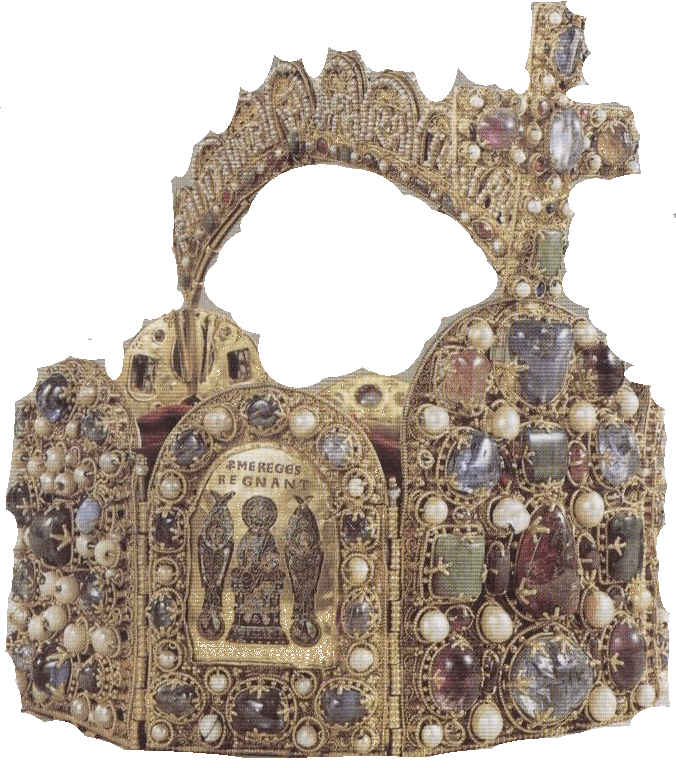
What a combination for one day, seeming to span the entire Habsburg rule (or at least the beginning and end)-- from the Crown of Charlemagne (10th century!) and coronation robes of Holy Roman Emperors and kings throughout the ages, to grand extravagant ornaments and jewelry, including an emerald larger than a human fist and long narwhal tusks... to an entire room devoted to the assassination of Franz Ferdinand--the car in which he was riding, the couch on which he died, and the uniform which he was wearing (complete with bullet holes and faded blood stains still visible). Very eerie.

In addition, I baked a yummy apple cake for my roomie's birthday! And I proved that gluten-free cake can be delicious, and that icing can be made without vanilla extract (which, in addition to pre-made icing, apparently isn't available in Austria).

I'm exhausted, and there's still so much German waiting.

Thursday, January 31, 2008

Settling in

I just came to the realization that as of today, I have now been outside of the US for the longest time in my life.  That's a scary thought, and if I hadn't counted the days, I wouldn't have believed it.  In high school, I was abroad for three weeks with a student travel program, yet those three weeks felt more like three months because they were so packed with activities.  

Instead, the three weeks in Vienna have seemed commonplace almost.  Lots of exciting things have happened, and my time here has definitely been busy, but I have also been able to settle in and make this place a home.  I'm comfortable here, and I feel as if I know my way around fairly well.  Point me to a U-bahn anywhere in the city, and I can find my way home.  Let me see the rooftops of the Oper or the Secession building and I'll find my way from there. Yesterday, just for kicks, I walked home a different way and found a great collection of Asian shops, including a Japanese tea room that I will have to check out in the near future.  Additionally, many of the grocery stores have American brands (Campbells, Heinz, Mars...) so those familiar tastes will be there if I ever do feel homesick.  Unlike England, Austria also has normal salad dressings, and I've found one that tastes like a Caesar-- es schmeckt mir gut!  And the whole hubbaloo about not being able to get peanut butter in Europe?  A myth!  I've found multiple brands of creamy and chunky, plus a lot of Nutella of course.  

It doesn't feel like I've been here for three weeks... it feels like I've only just arrived, and yet that I've been here forever.  :)


In other news, I had Turkish coffee for the first time today.  Came on a lovely golden platter, with the cezve and even my own Turkish delight!  Very delicious, but I was concerned that I was drinking it improperly or something, as the Ober kept staring at me.  ^_^

Intensive German finals start tomorrow with orals, and then written on Friday.  Eek!

Sunday, January 27, 2008

Coffee Houses

I think my last post satisfied the quota for pretentiousness. After all, who can resist a short brag to make one's self feel sophisticated? I suppose I did leave out the detail that that café reminded me of a diner, so of course I felt right at home. ^_^

The Viennese love their Kaffeehäuser, and it is no exaggeration to say that you can find a café on every corner (some are just better than others).


A personal photo of one of my favorite haunts--the Café Sperl.

The History (oder "Die Geschichte des Wiener Cafés"):
Coffee was first brought to Vienna by the Turks--the invaders! The second time that they besieged the city, the Turks fled before the Habsburg army and left their bags of coffee beans behind (1684 AD). The Viennese were rather bewildered by what these strange bags were, but after some experimentation, they discovered the wonders of Kaffee. A Polish general is said to have opened the first coffee house in Vienna, and since then it's been tradition. [Wikipedia's more extensive version]

There's coffee houses of all shapes, sizes, and styles. There's the over-priced touristy ones in the first district, there's the artsy and literary houses in the 8th and 9th districts, there's the famous ones that have been around for centuries, and there's the relatively new ones that are off-the-beaten-path and just waiting to be discovered. At all though, you are expected to sit and savor your coffee; while in the US we might only take a few minutes to sit with a cup of coffee or tea (if we sit at all!), the Viennese take their time, engaging in intense conversations or reading the newspaper or writing summer internship essays... for hours on end.


The fin-de-siecle architecture of the more laid-back Café Rüdigerhof

The Menu:
Many will have house specialties, but there are certain things you will find at any good Viennese coffee house:

-Melange- my favorite (rivaled only by the Schokolade-Latte, but not many places seem to have that). This Viennese specialty is like a cappuccino, but much better in my opinion. Here's the link to Wikipedia's explanation; sadly short though. It's also terribly disappointing that the first google search results I got for "Melange" was A) a fictional drug from Dune, and B) a geological formation.

-Brauner (großer or kleiner)- I believe that this is just your standard cup of black coffee, either large or small.

-Einspänner- about 1/3 espresso or coffee and 2/3 foam and whipped cream on top; it's an experience.

-Sachertorte- a chocolate cake (with fudgey icing and a smidge of marmalade), but really good chocolate cake. Invented by the Café Sacher (though its rival, Café Demel, also claims credit), this torte is now famous throughout the city and can be found in almost every coffee house; and for the most part, can only be found in Vienna. A must-try for any visitor.

-Apfelstrudel- another dessert for which Viennese coffee houses are famous--and well-deservedly! This flaky apple pastry is perfect for breakfast, lunch, afternoon tea, or dessert. Some days nothing pleases me more than a perfectly warmed apple strudel, with a flaky crust and fresh apples, topped with powdered sugar... mmmm!

-Topfenstrudel- Topfen might be best explained by comparing it to American cream cheese. Topfen, or "Quark" cheese, is a crucial ingredient to many Austrian desserts (including Topfenecken). Like Apfelstrudel, Topfenstrudel has many flaky layers of pastry and is filled with this delicious creamy cheese. In addition, it is often drizzled with a tasty vanilla sauce.


A good coffee house will serve a glass of water and a sweet with your coffee. The water serves many purposes; it is refreshing, it cleanses the palate so that you will savor your next sip of coffee more, and it is healthier to accompany coffee with water. [Viennese water is especially delicious, because it comes directly from the Alps-- no chemicals added!] Many coffee houses will serve your cup of coffee and glass of water on a small tray, accompanied by a small chocolate or cookie as the final flourish of taste.

I think that about covers it for now for Kaffeehäuser. Next week: Heurigen!


My photo of a typical melange inside the Sperl

Tuesday, January 15, 2008

Der Nussknacker!

I have just returned from my first experience with the Viennese Opera House. :)

The Opera offers an deals that make shows very accessible to students-- only 2 to 3.50€ (roughly $2.60-$5) for standing room tickets to see some of the best opera and ballet in the world. The opera house has a space on each level (from orchestra and up) in the center back reserved solely for theatre-goers who purchase these cheap tickets. They must be bought the day of, so for really good shows (such as Don Giovanni that opened Monday night with a world-famous cast) the lines for standing room tickets start hours and hours before the doors open.

I walk by the Opera daily and sometimes observe such lines. Tonight, a bunch of students from my program decided to take advantage of the deal to see the last performance of the Nutcracker. I don't think I've seen that ballet since 8th grade, but it was phenomenal. Add to that the fact that despite leaning on a railing for about 3 hours, we had one of the best views in the house (center orchestra!).

I'm going to have to take advantage of this deal often. Unfortunately, it means getting home sehr spät, and I have a lot of German homework waiting for me.


Sorry that I haven't been in touch at all! This week is very scheduled and crammed with German class, orientation activities, and trying to find time to get groceries and make food. By the weekend I'm hoping things will slow down more, and I'll be returning to AIM as soon as I can. Also, will finish the story of Mariazell. Till then, tschüss!

Disclaimer

The views expressed on these pages are solely belonging to the author and do not reflect the views of the Fulbright Program, the U.S. Department of State or its partner organizations.