Showing posts with label photos. Show all posts

Tuesday, October 25, 2011

Documented Development: Japan

This collection of photos demonstrates the recovery in one field in northern Japan over a six month period. The first photo was taken in March, just days after the earthquake and tsunami devastated the area; the second was taken in June; and the third in September.

As residents attempt to return to daily life, there is still a long road of recovery ahead, but the results after 6 months are truly incredible. If only those same methods could have been applied in Haiti...

Tuesday, November 9, 2010

New Blog Project

Through a generous travel-grant from my university, I've been given the opportunity to travel throughout Central and Eastern Europe to examine current 21st century perceptions about the communist past and the recent decades of transition in Central and Eastern Europe. After much delay, I've finally launched a blog project for this purpose (entitled Transitions 21).

I'll be focusing mostly on my observations and studies within Poland, Germany, the Czech Republic, Slovakia, Hungary, and hopefully also the Baltic and Balkan states, but I also intend to examine the perception of other countries, especially my native USA, toward this period of history and the Central and Eastern European region.

WM will continue to be my personal blog, and Transitions 21 will solely focus on this travel-study project for the next year or so.

Check it out: Transitions 21

1 Nov: All Saints' Day

Junikowo Cemetery
Poznań, Poland


Every. Single. Grave was cleaned and covered with beautiful flowers or fresh boughs and candles.


In keeping with Polish tradition, family members traveled long distances the days before (and after) All Saints' Day in order to gather at the cemeteries on Nov. 1 and pay respects to their deceased loved ones and relatives.


The cemeteries were extremely crowded, though it may not appear to be the case in my pictures. So as not to disturb the families on this solemn day, I only took photos in areas away from the other visitors.


Thousands of candles at the Katyń memorial


Coming soon: The night of candles.

Monday, October 25, 2010

Poznań Marathon 2010


Poznań Marathon, 10.10.10
from Aleja Niepodległości
runners from all over the world and all ages


And last but not least, my favorite participant, and the last runner of the day:

Sunday, September 26, 2010

Earth from Above

Earth from Above: A stunning collection of aerial photographs from around the world. Absolutely gorgeous and really makes you want to travel!

Thursday, September 9, 2010

Today's Photo: Rondo Kaponiera


Things I am not looking forward to: When this entire intersection, one of the busiest in Poznań (though I know it doesn't look it here), is practically shut down and remodeled beginning in 2011. The morning commute is going to become a nightmare.

(This also happened while I was in Wien and they were extending the U2 to reach the stadium. Looks like it's under construction again).

Oh, the things that a city will do for the Euro Cup 2012. Such as christening the stadium with a Sting concert. It's quite a big deal. There's even a countdown on the website for the number of days left. I'm trying not to make it known that I'm not the biggest Sting fan.

Friday, August 27, 2010

Snapshots from Poznań IV


Mechanical goats butting heads above the City Hall clock at 12 noon each day... a Poznań favorite!

Tuesday, August 24, 2010

Wednesday, August 18, 2010

Sunday, August 8, 2010

Bambergian Festival

Today Poznań and the surrounding Wielkopolska region celebrated the annual festival of the Bambergians. The Bambergians were Germans who were invited to live in Poznań in the mid/late 18th century. The population of Poznań and of all of Poland had declined drastically due to so many wars, plagues, and floods. This festival celebrates their unique roots. Though still celebrating their ethnic German background, the Bambergians sided with Poland during both world wars, and these soldiers reaffirmed their loyalty to Poland during their parade today. Here's a few snapshots:

Musicians walking around the Rynek to open the festival at noon


Soldiers


The "bamberka" statue in the middle of the Rynek, decorated in flowers for the day.
Bamberka

And, as I was not able to get a picture of the Bambergian women in their elaborate festive wear, here's some photos from Poznań's website:


Snapshots from Poznań

foggy morning

Sunday, July 18, 2010

Bookmark Dump

1000 Awesome Things: For when you're feeling down and want reminded of the amazing little things of life.

What English sounds like to foreigners: An Italian's imitation of American English prosody through rock music; I can't help trying to understand the words, even though it's all gibberish.

Paris in 26 gigapixels: Enjoy a detailed, zoom-able panorama of the city of love as if you were there.

Kodak's blog: Filled with beautiful pictures. Also see National Geographic's Daily Dozen Your Shot submissions. Beautiful images of the world!

Antique Photo Generator: Have your photos instantly turned into antique-style prints! This is quite fun to play with.

Sunday, September 20, 2009

Why We Travel

The New York Times released this project today to display photographs (and chronicle stories) from around the work.
Why We Travel (Submit your photos here)

Monday, May 4, 2009

The Most Livable City in the World

Just this past week, Mercer officially granted Vienna the title of 2009 Best Quality of Living, passing Zurich from last year... in other words, Wien is *the* BEST city in the world in which to live! (More details of the study here).

Of course, anyone who has lived in this beautiful imperial city could tell you that. ^_^ To celebrate, here's a smattering of my photos of this "very livable" city:

Stephansdom and centercity Wien

one of Otto Wagner's old railway entrances

yellow

stadium

Naschmarkt2

strawberries

Friday, May 2, 2008

Bad Aussee and the Salzkammergut

Yesterday was Der Erste Mai (May Day) as well as Austrian Labor Day... a national holiday! Classes were cancelled, and parades and festivities went on throughout the day. In the evening, we went to the Prater to half-priced rides and fireworks. (Unfortunately, the fireworks were lame because they only lasted 5 minutes ^_^). Today the fun continued, as this weekend is Stadt Fest Wien (the Vienna City Festival). There was music and tents (and balloons!) in Heldenplatz as well as performances and special events throughout the city.

But as promised, jumping back a few days to recount this past weekend:


Last weekend I visited Monika, my German teacher from the intensive period, who lives in the Salzkammergut region of Austria. This region is very scenic, full of snow-capped mountains, reflecting lakes, and small authentic towns. Monika was in Vienna for a conference, so she picked me up in the afternoon and we drove out to Bad Aussee (approx 4 hrs on the Autobahn). She simply requested an important stop along the way: the Lindt chocolate factory! :D The factory (in the middle-of-nowhere!) had a small shop selling very discounted delicious Lindt chocolate, and also had a tray of some free chocolates to sample. Mmmmm. I only bought a small box worth (about 8 bags of Easter candies for only 5€), but Monika bought two large boxes and a mixed bags... perfect for having on hand for classes and students. This was a delicious side-trip.

We arrived in Bad Aussee around 6pm, and as I walked through her front door, I was immediately greeted by her friendly Dalmatian Kiara and her two cats, Molly and Lily. I missed having close contact with animals, and I really enjoyed having pets for the weekend. Additionally, I wish I had taken a picture of the house. It was yellow and green, complete with typical Austrian woodwork and balcony. I had my own "holiday apartment" downstairs, with views down the street into the town and with the mountains beyond.

The next morning, Monika took me into town. I was impressed by how she seemed to know everyone--from the neighbors that drove by or were walking their dogs to the people that worked in the shops! First we stopped in a Dirndl shop where I was able to see some examples of the traditional Austrian garb. A dirndl consists of a bodice, white blouse, skirt, and apron, and most towns have developed traditional colors for their dirndl. For example, the Ausseer dirndl has a green bodice, a pink skirt, and a purple apron. These colors would be worn for young and old alike for traditional festivals.

A few blocks down, Monika was able to shop me the dirndl factory where they hand-print the fabric. It was very interesting to watch the woman work! She taped down a large square of the fabric on a flat worktable and used a long wooden block for a mold (dipped in paint) to press the pattern. I observed her making a plaid pattern (so just a plain block), but there were also carved blocks on the side that would create patterns such as small flowers or stags.

Next, we stopped in a gingerbread shop! Gingerbread is another traditional food of Bad Aussee. I bought a little bit to sample, and I can't wait to try it! :) From there, we walked through the town and she told me some more about its history. Bad Aussee is a spa town located on the point where two rivers from the Alps merge into one. It is famous because of the real-life Cinderella story of Archduke Johann and Anna Plochl. Anna was the daughter of the postmaster of Aussee. Johann, the brother of the emperor, met Anna and fell in love with her, ignoring social customs to marry the girl from the lower class. Ausseers are very fond of this story, and have a statue devoted to Archduke Johann because of everything he did for the region.


After exploring Bad Aussee, Monika drove me to Hallstatt. Hallstatt is the oldest town in Austria and one of the oldest in Europe-- it is 7000 years old!!!!!!! Its name has even been applied to a period of the Iron Age. Its Salt Mines also have some interesting more recent history as a treasure trove of the Nazis. Its beauty (argued to be the most beautiful town in Austria as well as the oldest) earned it a spot as a UNESCO World Heritage Site. It is located very scenically on the edge of a lake and framed by the Alps. Here is a view across the lake from Hallstatt:
Hallstatt lake

There are extensive salt mines in the mountains nearby; for centuries, the men worked in the mines, while the women loaded heavy piles of salt upon their backs and trekked for miles to transport the salt. Numerous monuments throughout Hallstatt honor these women, who had to continue their work even when they were 9-months pregnant. Many children were lost because of this hard life style. Today, however, Hallstatt flourishes instead from tourism rather than salt and the Salt Women are a thing of the past.

Another interesting part of the town was the ossuary at the Catholic Church. I have never seen anything like this before! Because the town is so old and there is so little space (the houses are almost one on top of another!), the church had little space for a cemetery. They would use their limited plots for temporary graves after a person died; however, after a while, their bones would be dug up from the grave and the space would be re-used. The bones were marked with the name and dates, decorated, and put on display in the ossuary. This is a picture from inside:
Hallstatt cemetery

After Hallstatt, Monika drove me through a variety of other towns, including the more spaced-out Gosau (so many green fields), and scenic views of Dachstein and other major Alpine peaks. The views were stunning.

Sunday I left in the morning to return to Wien. (See the previous entry for notes about the wonders of the Austrian breakfast I was served each morning!). Overall, it was a wonderfully relaxing weekend, and just the right medicine I needed for the end of the semester. I really hope to come back to the Salzkammergut one day though, hopefully to spend more time and hike between the various town, and who knows? Maybe if my German is good enough, I will follow in Monika's footsteps and retire in a wonderful town like Bad Aussee.

Sunday, April 6, 2008

Spring Break: Italia!

Tonight I'm trying to catch up on a bunch of posts at once. First and foremost-- my excellent spring break in Italy!

We caught a night train from Vienna to Venice and arrived in the city of canals around 8am, surprisingly well-rested. After dropping the bags at our hostel, we set out to explore. Venice is rather small and one can easily walk everywhere--no need to pay any hefty prices for a touristy gondola ride or get a public transportation ticket for a boat-bus. Venice's main street stays roughly near the Grand Canal and forms a full circle that incorporates all the major sites. We visited the Basilica of San Marco, the Arsenal, the Rialto bridge, and many other churches. Along the way, we passed hundreds of shops full of beautiful glass jewelry and masks. I had heard negative things about Venice and how touristy it has become, but I really enjoyed my brief stay in the city; it probably also helped that I was traveling with two other girls and we had a blast exploring all the unique little shops.

On Sunday we went to Palm Sunday mass in Venice, and watched a procession of palms outside a church for a later service. Then it was time to bid farewell to the sinking city and catch a train to La Spezia... from the eastern Italian coast to the western. After changing trains, we passed Florence and Pisa and arrived in La Spezia in the evening-- we had made it to the gateway of the Cinque Terre! Rather exhausted, we caught a regional train to the second town (Manarola) in which our hostel was located. Unfortunately, the train station was through a tunnel at the bottom of the mountainside. Rolling our luggage behind us, we stumbled up the steep winding streets of Manarola to where our hostel was perched high above. Our ravenous stomaches reminded us that we had never eaten dinner, so after checking in we trekked into the town and found an excellent seafood place for dinner (mmm stuffed muscles). The Cinque Terre, being located right on the coast, provided some of the best seafood that I have had in all of Europe.

We spent all of Monday outside, savoring the fresh air and the incredible views in the Cinque Terre. The Five Towns are (from north to south) Monterosso, Vernazza, Corniglia, Manarola, and Riomaggiore. We started by hiking the easy and scenic "Via dell' Amore" (Lovers' trail) from Manarola to Riomaggiore. Riomaggiore is the main town of the Cinque Terre; like all the towns, its main source of food is first the sea and secondly the vineyards. (Note that the sea in that picture does not do justice to the beauty of the ocean; see later shots). From this southernmost town we took the train north to Vernazza. We spent a good portion of time in Vernazza--eating lunch beside the crashing waves, walking around the town, and hiking up the mountain to a sanctuary and cemetery with a spectacular view.

From there, we caught the train up to Monterosso, but due to the time we didn't walk up to the main town (it is supposedly more built-up with hotels and restaurants). Instead, we stayed on the beach, one of the few sand beaches in the Cinque Terre. Anastasia, who is from the Midwest and hadn't been on a beach in the past 10 years, especially loved it. Caught the train to Corniglia and enjoyed this final town of the Five Lands. From Corniglia, we hiked back to Manarola, catching a great view (like a postcard!) from the path of our starting point perched on the cliff by the sea. We had dinner in another lovely seafood restaurant, right on the edge of town and overlooking the sea, sipping wine and enjoying muscles, crab, and pasta as the sun sunk low in the sky. But we couldn't stay for the full sunset. We hurried back to the hostel and gathered our bags, and from the Manarola platform waiting for the train to La Spezia, we watched the sun sink below the watery horizon. It was perfect.

I absolutely loved the Cinque Terre. One last favorite picture before moving on:


Florence was next. From Tuesday until Wednesday night, we explored the city of Dante, Michelangelo, Machiavelli, Galileo, and countless others. In fact, we saw the tomb of those latter three names (plus a Cenotaph to Dante, as the exile never returned to Florence) in the Church of Santa Croce. This church also had frescos by Donatello. Also went inside the Florence Duomo, which has this famous painting of Dante and his Comedy. Needless to say, this fan of Dante was loving every moment of being in a city where everything from the streets to the restaurants were named after the famous poet. (And yet Dante actually spends most of the Comedy bashing his home city of Florence). We explored many of the famous piazas, saw the fake David (not wanting to pay or wait in line for the real one), and walked Ponte Vecchio. Wednesday morning we woke up at dawn in order to get in line for the Uffizi gallery. This extensive art museum, which houses the treasures of the Medicci family, is one of the greatest art collections in the world: Botticelli, Michelangelo, Da Vinci, Raphael, Rubens, Rembrant, and more. As an individual who has rarely had the opportunity to see the great masters before this semester, this was a truly incredible experience.

To celebrate our final hours in Firenze, we kept up our tradition of "A Gelato, A Day" by going to a 70 flavor gelateria. I had a lot of gelato in Italy, but this was my favorite place. We enjoyed incredible flavors such as rose, grapefruit, chocolate mousse, papaya, kiwi, blackberry, and a mixed melon flavor which was my favorite of the day... not to mention all the crazy flavors that I'm not even sure what they were! ^_^


Onward to ROMA! We were in Rome for Easter, which was overwhelming but also a once-in-a-lifetime experience. We were able to secure tickets to all of the papal masses and thus celebrated mass with the pope four days in a row. Crazy! The crowds for these masses were unbelievable... though tickets are required to attend, more tickets are printed than people could possibly fit inside the building, so you need to get there at least two hours ahead of time. On Holy Thursday, we learned what an "Italian line" is. Basically, there is no line, just a lot of people pushing forward in a solid herd. We were very lucky to get inside and get seats for every mass.

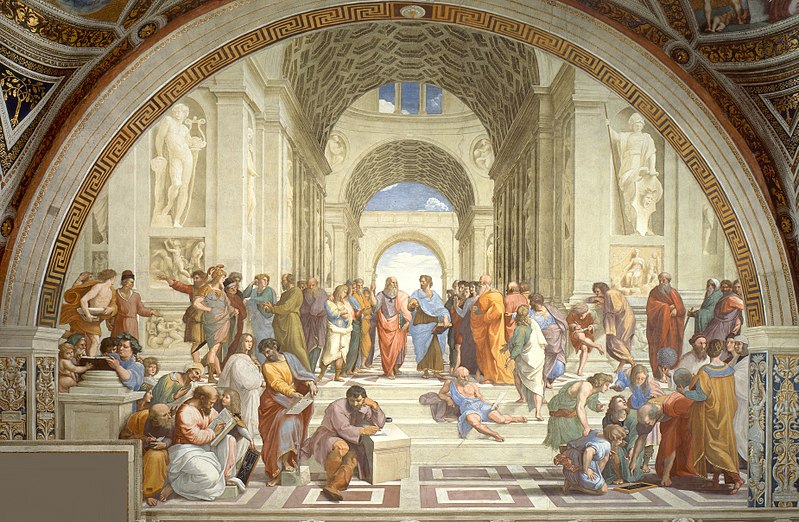
Thursday we explored the city, highlighted by the visit to the Pantheon, which is now a Christian basilica and houses the tomb of Raphael. Friday we woke up very early once more in order to go to the Vatican museum. We arrived before it opened, but still stood in line for 1.5 hours until we got in the doors. We took our time once inside, savoring the treasures of sculptures, maps, paintings, and artifacts. We saw the Rooms of Raphael, which include the School of Athens (not my picture) and on other walls, paintings that include Dante ^_^. The collection was incredible! The crowning highlight came at the end of the museum--the Sistine Chapel.

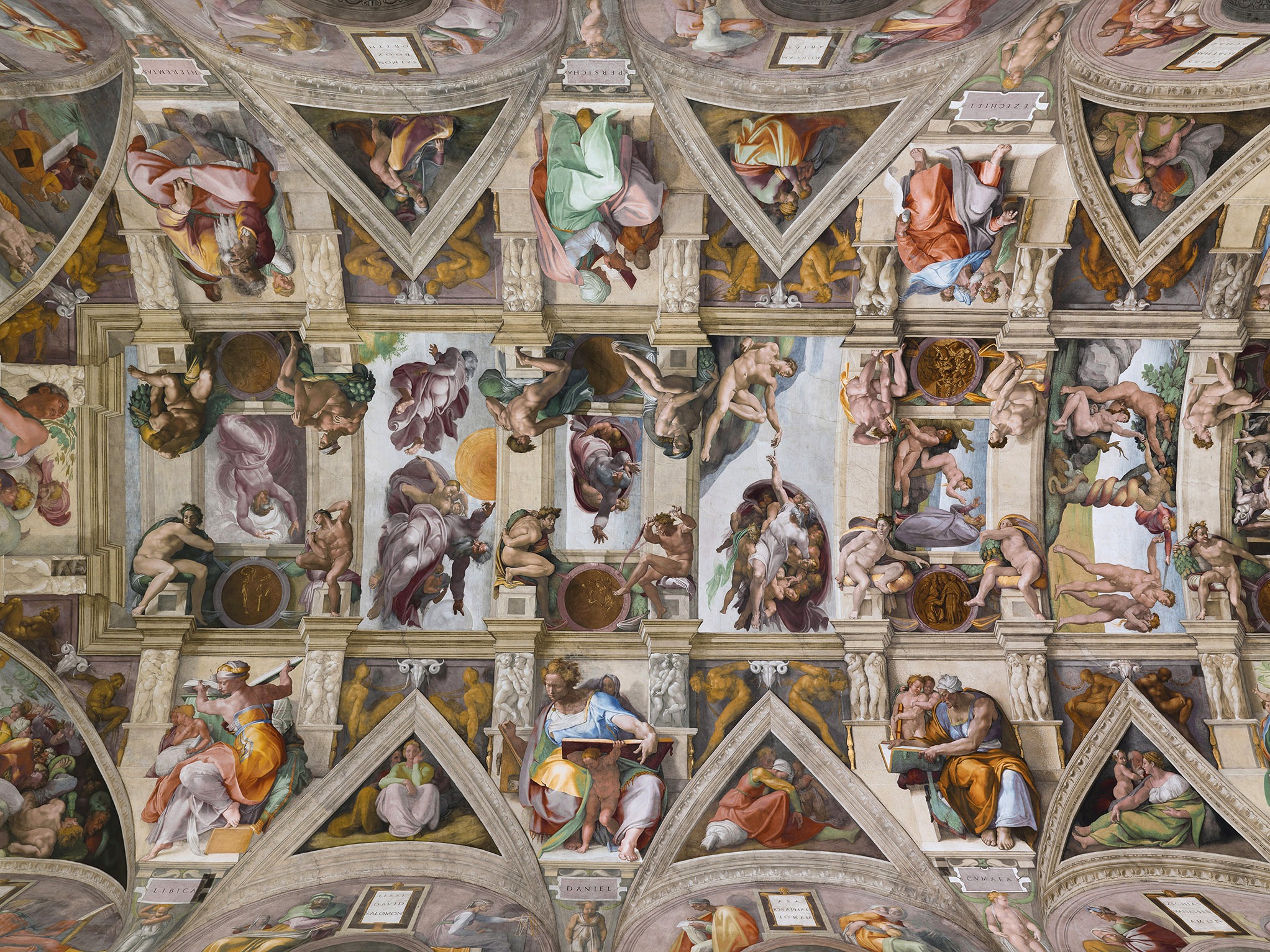
I can't say how long we spent in that one room. I had always pictured a small-ish, round chapel, with the painting of God and Adam focused in the center, but it was far and beyond my expectations. No pictures of it really do the room justice; indeed pictures are not allowed in the room so these are not mine. There is incredible artwork on every wall, in every nook, to the point that there is too much to see. Michelangelo painted the ceiling, which traces creation through the Fall of Man/the Flood. The walls are covered by Biblical scenes by the masters, Botticelli among them, with scenes from Moses' life on one side and Jesus' life on the other. Behind the altar is another of Michelangelo's masterpieces: The Last Judgement.

Saturday we went to the Catacombs south of the city. Portions of Catacombs, or labyrinthine tunnels that served as safe havens and burial places of the early Christians, continue to be discovered in areas around Rome. We were able to descend into these old passageways and walk in the old cemetery or "sleeping place". There were thousands of shelves and the pieces of plaster or marble on the walls that used to cover the front of the shelf. These plaster slabs from the early centuries AD were decorated with Christian scenes and symbols that are clearly distinguishable to any Christian today. It was spiritually moving to see, for the first time, and ancient site that used not only a language that I could (sort-of / pretend to) understand but also a religion that I was intimately familiar with. This was not hieroglyphs or cuneiform, but something that connected closer to me and my own life experience.

We spent the rest of the afternoon at the Roman ruins, exploring the grounds of the old Forum and Augustus' House. We ended up going to the Colosseum Sunday afternoon instead. It was very impressive just how much of this ancient civilization is still in excellent condition!

Sunday we attended our last papal Easter service--Easter Sunday mass in St. Peter's Square. It was amazing to see so many thousands of people gathered into one place for a mass, including more of the religious (priests, nuns, etc) than I have ever seen. In addition, the enthusiasm of this multicultural crowd was incredible. A group of young Latino girls near me shouted a song-like chant with claps and waving their flag to "Viva le Papa!" Hundreds of flags waved throughout the square, despite the pouring rain (everyone was completely soaked by the end, but we stuck through). It was a collection of patriotism and internationalism and mixed backgrounds, but all gathered for one purpose. In the end of the service, Pope Benedict read a final blessing which included wishes for a "Buona Pasqua" or "Happy Easter" echoed in more than 70 languages. Even though we couldn't communicate with most of the people we were seated beside, it still felt united and connected.

Monday we caught an early train from Rome to Milan. We explored the famous city of fashion for a few hours, though most places were closed for the national holiday of Easter Monday. Left in the early afternoon to catch our plane back to Vienna and return to classes the next day.

It was a whirlwind trip, but I fell in love with Italy. In one trip, I saw major works by all of the ninja turtles, including the tombs of two of them. I tasted genuine gelato every day, and now there's no going back. I saw scenic views and incredible buildings, and tasted delicious dishes. It was almost too much for just a week and a half, and I look forward to the opportunity to return.

Thursday, March 13, 2008

Hitler and Vienna

Today, or I suppose yesterday, was the 70th anniversary of the Anschluss. On this date, seventy years ago, Hitler and his Nazis marched into the streets of Vienna to be greeted with cheers and crowds of supporters. That evening, Hitler came to Heldenplatz (or "Heroes' Square), which is directly below the new wing of the Hofburg palace, the former winter residence of the Habsburg monarchy. He entered the palace, and climbed to the grand balcony of this Neueburg; from the balcony he spoke out across the square to the masses that had gathered in support. Hitler, who was born an Austrian but left Vienna after rejection from art school**, was welcomed back to the city as a hero. Following this event, Parliament was dissolved, the country was absorbed into Germany at last; Austria disappeared from the map for the next seven years and the world fell in to another more terrible World War.

**Adolf Hitler was born in Austria, not far from Linz. He came to Vienna to study art, but after he was rejected from the Art School multiple times, he moved to Germany. I have recently learned that his old apartment is only about a mile from where I live. He used to frequent a coffee shop, the Cafe Sperl, that is a short walk from my apartment and which I have visited multiple times. How eerie and disturbing!

Last night, on the evening of March 12, 2008, the Volksgarten and lawns of the Heldenplatz were covered in 80,000 candles as a memorial to the events of March 12, 1938. Last night there were masses gathered once more in Heldenplatz; but these were not crowds that were riled up by the words of one terrible man, but somber crowds that walked between the groups of candles, quietly remembering and reflecting on a past singed with guilt and so many lost lives. 80,000 candles were prepared for the memorial, one candle to signify each lost Austrian life. The people of Vienna took the candles at dusk and arranged them into meaningful patterns across Heldenplatz and the Volksgarten, creating a garden of light. Some common symbols were the Star of David and the peace sign.

Events continued through the day to mark the anniversary of the Anschluss. On Mariahilfestraße (a popular shopping street), I saw a woman dressed as Hitler, using a megaphone and a grave voice to call upon everyday shoppers to take a moment to remember and never forget the past. Various exhibits are on display at the museums, and the Opera will do a special study of how the building was used during Nazi occupation. Though an anschluss and merging with Germany was welcomed and praised at the time (since the end of World War I, the Austrians had longed to join Germany and return to some semblance of an empire), hindsight is 20/20. March 12, 1938, was a very grave day indeed in Austrian history.

To close, here is a picture of the candles of Heldenplatz. I am sitting beside one of the Stars of David:


I leave for Italy tomorrow and will not have internet access. Have a blessed Easter and a relaxing spring break! Tschüssbaibai!

Thursday, January 17, 2008

Orientation: Take 2 (pictures!)

(I'm working on resizing the pictures, but for now just click on each image to get the full view and full appreciation of them).

I'm amused that Blogger continues to have its entire main page in German for me.  At least I figured out what "anmelden" means now.  ^_^

Picking up where I left off...

Friday morning we had more orientation lectures, followed by our written German placement tests.  An essay, a dialogue, and reading comprehension.  Not too hard.  Later that afternoon we met in small groups with the coordinator to discuss our training and determine that we were in the right level.  Elementary II for me!

During the break that afternoon, I walked with Beth to town.  We didn't really know where we were going, but that made it more exciting.  We passed many typical Alpine homes, an old abandoned tavern, and more.  Near town, we found this cemetery: 
Alpine cemetery

So beautiful.  Mariazell is a religious site and pilgrimage destination, so we saw countless shrines along the way.  After almost getting lost multiple times, we located the spires of the Basilica again in the distance and successfully made our way to the main streets of Mariazell. 

The inside of the basilica was even more lovely than the outside, and covered with intricate designs, golden altars, and huge brightly colored ceilings depicting scenes from the Bible and Austrian history.  The basilica was finished in the 1300s, but it recently underwent major renovations for the pope's visit last spring, to commemorate 850 years of Mariazell.  Afterwards, we wandered the shops nearby and met up with fellow students to take a tour of the schnapps factory.  Mariazell most famous for its miracle, but also for its gingerbread and schanpps (that fed and warmed the pilgrims after their long travels).  Unlike schnapps in the United States, authentic schapps are not sweeted with artificial flavors, but are made from herbs and intended for medicinal purposes (such as a stomachache after a big meal).  We only sampled small portions, but that's some pretty powerful stuff!

One last view of Mariazell (the basilika):
Basilica


Saturday morning began with the stress of the housing lottery.  I lucked out that one of my friends was number 10, so my group got housed early on.  Our apartment is huge and in an excellent location.  Most people seem very happy with their housing, but I feel like we got the best of the best.

That afternoon, a group of us decided to go hiking.  There was a chapel high up on a hill right above the hostel, so we hiked up the old trails to it.  The chapel itself seemed locked up for the winter season, but its grounds provided an excellent view of the entire valley.  

After standing in awe and staring out across the vast landscapes for quite a while (and taking pictures of course!), we set off again to continue our hike on a nearby trail we had found.  This trail provided to wind along through the valley along the river.  The path was scattered with occasional shrines and tiny mountain streams from freshly melting snow.  Absolutely gorgeous.

I will leave you with this photo, from the view of the chapel:

Photobucket

Disclaimer

The views expressed on these pages are solely belonging to the author and do not reflect the views of the Fulbright Program, the U.S. Department of State or its partner organizations.