Tuesday, December 29, 2009

The End of a Decade

As 2009 draws to a close, bloggers, artists, and journalists everywhere are scrambling to reflect upon the past ten years. Naturally, in this decade of the Blog, of Google, of YouTube, and of Facebook (it's hard to believe that none of these concepts existed ten years ago), this reflection is taking many diverse forms.

First, there's the usual collection of different lists of favorites (videos, music, theater, etc.) from the year. As usual JibJab released a comical video immortalizing 2009 in song and dance. Dave Barry wrote his annual year in review.

My favorite 2009 tribute goes to DJ Earworm, who created this clever mash-up of the top 25 pop songs of the year:


However, reflections on the decade as a whole present additional challenges. To start with, what should we call these past ten years? We've had ten years to decide how to pronounce the '00s, and with perfect procrastination, we failed to reach any consensus. Personally, I'm a fan of reviving the term "aught", which was used to describe the years of 1900-1909. (For example, '05 was pronounced "aught five"). Paul Krugman argues reflects on all the negative trends between 2000-2009 and thus suggests that the decade should be remembered as the "Big Zero".

The past decade certainly did bring a lot of challenges, and it bears careful remembrance and reflection. For those with only a few minutes to spare, Newsweek released a comical fast-talking review of the decade in seven minutes through headlines and old news reels. For those with a bit more time to spare, the Daily Show released a fantastic year-by-year review of the decade through old Daily Show clips to sum up the main events.

NYT is again seeking photographs from readers, this time in order to document the images of the decade. (EDIT: Here's the collection of a decade of photos). Paste considered fashion and examined the evolution of the hipster in this past decade through images.

However, my favorite tribute so far is the You Aught to Remember blog. This blog has been posting an entry a day for the past hundred days in order to reminisce about various events and (pop) cultural phenomenon that were quintessential parts of 2000-2009. Though this blog will be completed in the next few days (only 4 more entries to go!), the archives provide a comprehensive look back over the past years.

For auld lang syne, my dear,
For auld lang syne,
We'll take a cup o' kindness yet
For auld lang syne!


Happy 2010.

Tuesday, December 15, 2009

'Tis the Season

I loved this article on Weihnachtsmärkte in Germany. Such Christmas markets can be found across Germany, but the Berlin markets have especially specified and diversified. The NYT offers examples of a market for kids, a market for GLBT, and a market for environmentalists.

Hurry, because these markets traditionally close by Dec. 24!


Can't get to Deutschland or Österreich this year? A number of U.S. cities have adapted the tradition and added their own Christkindlmärkte.

Frohe Weihnachten und ein gutes Neues Jahr!

Rust Belt Tourism

USA highlighted Buffalo today and its efforts to regain its place as a city of architectural grandeur. As one who enjoyed architecture and an amateur urban explorer, I found the images intriguing and the building listed probably worth a visit, even if not fully restored.

Some more images of Buffalo, courtesy of Flickr.

Thursday, November 19, 2009

Souvenirs

As one whose favorite souvenirs are often a pebble from a beach (Cinque Terre) or a collection of napkins and coasters from bars and restaurants (across Europe), I find the Frugal Traveler's essay on souvenirs to echo my sentiments exactly: Souvenirs on the Road

Tuesday, November 17, 2009

Velvet Revolution

Today marks the 20th anniversary of the beginning of peaceful student demonstrations against communist rule in Prague, Czechoslovakia. These demonstrations culminated to become the Velvet Revolution, which achieved its ultimate goal of overthrowing the communist government on December 29.

Unfriend


Facebook has truly permeated our culture. The OED announced today its Word of the Year for 2009: "Unfriend" (or "defriend"), that is, a new verb to describe the act of breaking off Facebook connections with someone and de-linking profiles.

Antonym: to friend (someone), i.e. "Sue friended the girl she met yesterday." Also see: to facebook (someone), which is sometimes used as a synonym for friended but also implies facebook-stalking.

In other Facebook news, the social networking site now offers language options that include English (upside down) and English (Pirate).

Tuesday, November 10, 2009

20 Years - Die Berliner Mauer

By this hour, 20 years ago tonight, the Wall had opened and East Germans flooded into the West. They say that most simply crossed in order to say they did, in order to walk on Western streets, in order to buy something from a Western store; then, after wandering for a few hours, they crossed back over the barrier that no longer carried any meaning.

The commemorations and reflections have been almost exhaustively numerous on this historic anniversary. (Also check out the concert by the Brandenberg Gate). It was a time to remember the images of the day but also consider the boundaries and debated legacy that remain.

Lest Americans forget, Ronald Reagan's famous words were uttered more than two years before the Berlin Wall opened, and he played next to no direct role in the opening. However, his relationship with the reformist Gorbachev epitomized the thaw of the Cold War. Gorbachev did not attempt to crush revolutions, as his predecessors had, but instead embraced reform even as the hard-line East German leaders dug in their heels. Poland had already elected a democratic government, Hungary had torn the Iron Curtain by opening borders with the West, and the Czech Republic would soon follow. However, in the end, it was a mistaken word at a press conference that caused the Wall to open so suddenly, unleashing the flood of humanity into the streets of West Berlin on the night of November 9-10.

The rest, as they say, is history.

Tuesday, November 3, 2009

A Step Toward a United States of Europe?

... or perhaps just a breath of fresh air to make the unwieldy EU structure a bit more manageable. Either way, the Lisbon Treaty has now been signed by all 27 EU member states and may take effect as soon as December 1. The Lisbon Treaty updates the original 1992 Maastricht Treaty, which formed the European Union, and provides a permanent presidency and foreign minister.

This has been a long time in coming; the ratification of the Lisbon Treaty by all the EU member states has taken almost two years--one could argue that that delay itself emphasizes the need for such a treaty. (Indeed, the origins of the Lisbon Treaty can be seen in the proposed and rejected European constitution, which goes back to 2005). Will the creation of a permanent EU presidency and unified foreign affairs activity gradually rob member states of national sovereignty, as many fear? Time will tell.

Monday, November 2, 2009

Rumblings from the Rubble of the Wall

The anniversary of the Berlin Wall's opening is fast approaching, and rumblings of memory and warning are arising in the media. Today, the Times published a column written by Mikhail Gorbachev, reflecting on the momentous year of 1989 and the results of his perestroika and glasnost. Another opinion peace warns Americans to remember the facts of the day-- the sudden opening was an accident, a mistaken word that resulting in the quintessential image of the fall of communism and (from the US perspective) the perceived American victory.

Thursday, October 29, 2009

2 for $22

Don't miss Open Letter's "2 for 22" deal. Choose any of two of their books from previous catalogs and pay only $22! Get them before they're gone.

Friday, October 23, 2009

A Piece of History

The New York Times is collecting photos and stories about the opening of the Berlin Wall and individual accounts of where you were and what you remember about that historic time.

Monday, October 19, 2009

Frankfurt Book Fair

The world's largest international book fair is held every October in Frankfurt, Germany. The 2009 Frankfurt Book Fair was this past week, featuring trade publishers from around the world and open to the public October 17-18. Every year, the Book Fair chooses one Guest of Honor in order to highlight the books and literature from that country; this spot can be controversial, and has previously been awarded to Catalan culture and Turkey. This year proved tense as well; China was the Guest of Honor and, according to the NYT, seemed to exhibit its struggle between desiring Western markets but despising Western dissidents.

A (Musical) Step in the Right Direction

Can we duplicate this in the US, please?

Friday, October 16, 2009

The Boy and the Balloon

Some stories do end happily. The nation held its breath as the events unfolded this afternoon regarding a Colorado boy and an escaped weather balloon, which he was playing inside of before its tether broke loose. It was scary to think of a 6-year-old thousands of miles up in the atmosphere, but when the balloon descended without the boy inside, many feared the worst. It was a relief to come home tonight and read that the boy was actually safely on the ground the whole time.

Monday, October 5, 2009

The Passing of a Polish Hero

The last surviving commander of the Warsaw Ghetto Uprising, Marek Edelman, died this past Saturday. The Warsaw Ghetto was established by occupying Nazis 69 years ago this month.

Simple Instructions

For the wanderers, the children-at-heart, and those who simply desire straightforward instructions to a complicated world: "Instructions" by Neil Gaiman, which will be published with illustrations in the near future. Unfortunately, I do not have any pictures to share of his book signing yesterday, as the auditorium was so full that the security guards would not allow me to enter. Ah, the curse of always running late.

So instead, an image of a word for all those restless wanderers and linguistic geeks out there (courtesy of C):

Tuesday, September 22, 2009

Butternut Squash

I adore butternut squash. It's definitely up there on my list of favorite vegetables, after asparagus, eggplant, and artichoke, of course. I love butternut squash ravioli and Mom's butternut squash soup. However, funny thing is, I haven't the foggiest idea of how to cook with it.

At the market last week, one of the farmers brought a truckload of his butternut squash. At only 50¢ and fresh from the local harvest, I could not resist convincing myself that I'd figure out how to cook it later and buying one.

Luckily, a woman from a neighboring stall saw my distress and recommended her favorite way to cook butternut squash as a side dish. Unfortunately, she did not give proportions, but this leaves more flexibility depending on your taste for sweetness. You will need the following:


1 small butternut squash
2 Tbsp butter
1/3 cup brown sugar (more if you have a sweet tooth)
water
Oven: pre-heat to 350

1. Cut the squash into cubes, removing the skin and seeds in the process. Set seeds aside. Cubes should be no bigger than 1 inch x 1 inch x 1 inch. (If you are in a hurry, cut smaller cubes as they will cook more quickly).
2. Place squash in a pan with high sides; if cooking for one, I recommend a bread pan. Be sure to spread out the squash evenly along the bottom of the pan.
3. Cut the butter into smaller pieces and place on top of the squash.
4. Sprinkle the top with brown sugar. (This could also be a delicious dessert treat, but if so, you may want to use more butter and much more brown sugar).
5. Pour water into the pan until the tops of the squash cubes are completely covered.
6. Place the pan into the oven at 350 F for approximately 30 minutes.
7. Let stand to cool. Serve, and enjoy!

Toasted Seeds: A simple healthy snack
1. Scoop out the seeds from the squash and spread them out on a sheet of foil.
2. Place seeds on foil in oven with squash for about a half hour or until lightly browned.
3. Drizzle honey over the warm toasted seeds and enjoy.

Sunday, September 20, 2009

Why We Travel

The New York Times released this project today to display photographs (and chronicle stories) from around the work.
Why We Travel (Submit your photos here)

Thursday, September 17, 2009

70th Anniversary of World War II

This is a year fraught with anniversaries. Not only did the Eastern Bloc open to the West 20 years ago this year, but World War II also began 70 years ago this month.

On this date in 1939, the Soviet Union invaded Poland. Sixteen days earlier, on Sept. 1, Germany had invaded Poland; this resulted in the declaration of war and the beginning of World War II in Europe.

By early October, Germany and the Soviet Union had divided and annexed the whole of Poland. This occupation continued until 1945 when borders were redrawn. World leaders have commemorated these historic anniversaries and apologized for the past, though some may argue, not enough.

My 1989 timeline has been a bit delayed, so keep an eye out as I go back to note the events of August and Septemeber 1989.

Saturday, August 22, 2009

From Oppression to Opportunity for Women Worldwide

This week, the Times published the following powerful piece on the plight of women in poor countries, the success of microfinancing when directed toward women, and what this could mean for global assistance. It's long, but well worth the read.
The Women's Crusade

Friday, August 14, 2009

Packing Woes

Packing to move to a new place. Packing up months later to move back. No matter how many times I do this, I cannot seem to fall into a routine. Every time, I end up discovering that I have more belongings than ever before. Every time, I end up trying to bring more stuff but have less space. Every time, everything seems left until the last minute.

I wish I could offer substantial packing tips, but unfortunately I'm both a packrat and a procrastinator. Best tip: Start as early as possible. Also, try playing good music to postpone the inevitable frustration.

If only I took my own advice. Now, back to the jungle of boxes and suitcases!

Monday, August 10, 2009

DC's Second-Hand Bookstores

In case you haven't noticed from all my posts about books, I adore books and I love bookstores. But beyond the large commercial chains, I'm especially passionate about independent bookstores. And I'm more-than-a-bit obsessed with second-hand/used or rare bookstores.

When traveling, I seek out such bookstores, such as Another Country in Berlin. In Vienna, I frequented Yellow Taschenbücher by the University. In New York, I was a regular at Strand. One day I will make it to the famous Shakespeare & Co. in Paris. Yes, my bookshelves are currently overflowing with more books than I have time to read, but I feel as if I come alive when I enter a bookstore to be surrounded by volumes of art and knowledge. There is so much yet to learn! (Also, seems like every time I enter, I leave with more titles that I need to add to The List).

In a tiny corner near the Eastern Market, often only found thanks to the simple sign of "Books" with an arrow, stands Capitol Hill Books. If you do not notice the faded awning, you might not even realize the name of the store that you are entering. The window is crowded with stacks upon stacks of books, almost obscuring the tiny sign that declares the place "open". Upon entering, you are at first unsure how to proceed: Choose the steep and narrow path up the stairs, crowded with tall piles of books on every step? Or take the turn to the left to stay on the ground level with a low ceiling and an unknown path ahead? A gruff voice barks out from the left: "Fiction upstairs, nonfiction downstairs!" Perhaps you peer around the corner to connect the voice with an older man at a desk that serves as a check-out, surrounded by piles of books and newspapers clipping, manually processing ever transaction with a pen and paper. Then you scamper upstairs, attempting to not knock over any of the precariously placed piles of books on the steps.


My photos of Capitol Hill books

This was my haunt in DC. Capitol Hill books only offers used books, but it is a Mecca for all bibliophiles. Once you are surrounded by your genre of choice, it is hard to suppress a childlike grin. Every title is tempting and accessible (and affordable!) and it's easy to grab a spot on the floor and start reading--just watch out for the other bibliophiles who will have to step over you to get through! The place is haphazardly arranged and feels organized by a packrat, but the character of this bookstore continues to draw patrons. You don't go to Capitol Hill Books to quickly find a specific title; you go to wander through and find a title that you never knew existed.

A bit more about the visual beauty of the place. The floor-to-ceiling books provide huge varieties but often might be precariously perched and rarely offer much space to move around. Be sure to check out the poetry room (upstairs in the back, surrounding the refrigerator and broken sink), the basement (Sci Fi, Latin American politics, Native American studies, botany, etc), and the "Foreign Language room" (a.k.a. the bathroom. Shelves of non-English books surround the toilet, but you must wait in line if someone has to use the loo).

I highly recommend Capitol Hill Books to all bibliophiles, but NOT to claustrophobics.


Also check out a couple of spots near Dupont Circle: Second Story Books, a less claustrophobic second-hand and rare bookstore; and Kramerbooks, an eclectic store of new books and a tasty cafe.

Thursday, July 30, 2009

Gelato Dreamland

Last night I dreamed about Zanoni & Zanoni. Such a wonderful place, and right in the heart of Wien near Stephansplatz. So many delicious flavors of gelato, all needing sampled!

I especially miss the 2€ Blumentüte, a giant "flower cone" which could hold three scoops/flavors of different gelato. In other words, it's a student's dream. I have yet to find any gelato in America that can begin to compare.

Tuesday, July 28, 2009

Recipe: Asparagus, Goat Cheese, and Chicken, oh my!

Waltzing Matelda goes gourmet!

Or so I felt when baking with asparagus and goat cheese. I tweaked and substituted ingredients in an old epicurious recipe and ended up with a very different dish. (Originally artichokes, fontina cheese, and sundried tomatoes).

Chicken Stuffed with Asparagus, Goat Cheese, and Sundried Tomatoes

4 chicken breasts
1/2 C. sundried tomatoes, cut into very small pieces
1 bunch of asparagus, diced very small
8 oz. (or about 1 C.) goat cheese
Oregano
Olive Oil
Optional rosemary, salt, pepper

1.) Boil a pot of water, and preheat oven to 375 degrees F.
2.) After reaching rolling boil, add diced asparagus for one minute, only 60 seconds. Do not overcook! After one minute, remove from boiling water and drain asparagus. Run cold water over the strainer to cool down the asparagus and prevent additional cooking.
3.) In a medium bowl, mix chopped sundried tomatoes, goat cheese, and asparagus. Add oregano and optional rosemary to this mixture.
4.) Using a sharp knife, work with each chicken breast one at a time to cut a slit in one side, opening up the middle of the chicken breast to be stuffed.
5.) Stuff each chicken breast with the cheese mixture. Be careful not to overfill; the mixture should be packed into the chicken breast, but the chicken should not be bursting. If possible, try to squeeze the slit closed once full.
6.) Heat approx 2 Tbsp of olive oil on the stove. Add stuffed chicken breasts; cook on one side for 2 minutes; flip over and only briefly cook on the other side. Add to an oven-safe pan.
7.) Put the pan of chicken in the oven for approximately 15 minutes at 375 degrees F until cooked through.

Another tasty recipe: Mediterranean Chicken with Eggplant

Support for East European Democracies

Another 1989 landmark: It has been 20 years since the US started providing funding and humanitarian aid toward the development of democracies in Central/Eastern Europe. Since 1989, this contemporary Marshall Plan has "graduated" a number of states, from Estonia to Poland to Hungary to Croatia. US aid in the region continues its efforts in the Balkans and former Soviet countries.


A poster advertising the Marshall Plan, otherwise known as the
European Recovery Program, after WWII

Wednesday, July 15, 2009

National Days

Also, Happy Bastille Day (France, July 14)! And a belated Happy National Day (Montenegro, July 13)!

Early July is apparently a very popular time for national holidays.

Sing-along with Gazprom

In the tradition of "Someone Like Putin", a new song is topping Russian charts, which praises the government-owned natural gas monopoly, Gazprom.


Russia holds the largest reserves of natural gas in the world, and Gazprom controls these reserves and the pipelines, servicing much of Europe and Eurasia. Thus, economic disputes often become political, such as when Russia cut off the gas to Ukraine in January of this year. Actually just yesterday, Turkey and the EU signed an agreement to build the Nabucco Pipeline, attempting to bypass Russian soil and thus avoid Russian dependence.

Saturday, June 27, 2009

Eastern Market festivities!

Eastern Market is reopening their North Hall today (in renovation since the 2007 fire), and festivities continue through tomorrow. If you're in DC, check the schedule and come check it out!

Monday, June 22, 2009

You know you're new to Washington when...

... you see someone wearing a "W" in script on a hat and immediately think it's the insignia for Wegman's, not understanding why someone would be sporting the supermarket's hat on the metro. At the next stop, when a flood of other people get on wearing various "W" gear--hats, shirts, bags--you realize that it's the insignia for the Washington Nationals who played today.

I contend that it was an honest (albeit amusing) mistake, from one who does not closely follow baseball and who misses having the Wegman's supermarket nearby. ^_^


Side-by-side the truth is more apparent: differences in script in the W for Wegmans and the W for the Nationals.

Saturday, June 20, 2009

Go Remy Arlington Rap

Anyone who has lived in the DC area, especially in Arlington, will appreciate Remy's latest feat:


... at the Starbucks or the Starbucks or the Starbucks or the Starbucks...

Wednesday, June 17, 2009

June 16, 1989

First of all, as we can't be neglecting our literary dates, Happy Bloomsday!

Twenty years ago, June 16 proved to be the second step toward the fall of communism in Eastern Europe. Just days before in Poland, Solidarity had emerged victorious in the first free, democratic election in all of Eastern Europe. June 16, 1989, was a day of symbolism for Hungary, but this symbolism proved most powerful. On this date, the Hungarians performed a reburial--a reinterment of a man who was once regarded as a traitor, an enemy of the state, and perhaps even Hungary's most potent criminal against communism.

In 1953, the Hungarian Communist Party selected reform-minded Imre Nagy as their new Prime Minister, but he only lasted two years before falling out of favor. In October 1956, the people called for a change and students discontent with communism, led to the Hungarian Uprising. Amidst tumult and revolt, the people of Hungary called on Nagy as their revolutionary leader. Indeed, it is hard to understate the significance of the 1956 Hungarian Revolution; not only is it regarded as one of the proudest moments in Hungarian history, but it also marks the first major revolt against communism and the USSR--indeed, a revolution against the revolution. But in November, Soviet tanks invaded Hungary. Nagy was arrested and, along with other leaders of the revolution, executed and dishonorably interred.

Decades later, the Soviet Union was beginning to weaken, and a more flexible and reform-minded Hungary was passing legislation toward democracy. In May they had removed barbed wire from the borders with Austria, the first step toward opening borders with the West (!), and thus slowly tearing a hole in the Iron Curtain. In this spirit, on June 16 the grave of Nagy and his revolutionary comrades was opened, and they were honorably buried with pomp and respect. 250,000 people are estimated to have attended his reburial.

The Reinterment of Nagy was just another step away from the USSR and toward democratization. However, historians today consider this symbolic act as the keystone in Hungary's strides toward democracy in 1989; the symbolism became the strongest mark in their break with communism. Like Solidarity's election in Poland, Nagy's reburial marked the rise of a New Europe, encouraging and accelerating revolutionaries in neighboring Czechoslovakia and East Germany.

Some time after Nagy's reinterment, a statue was built to commemorate the leader. He is posed on a bridge, staring wistfully toward the Hungarian Parliament building. Twenty years after the event of his reinterment, Hungarians celebrated their hero and the change he wrought--both in life and in death.


Imre Nagy's statue looking toward the Hungarian Parliament (my photo, May 2008)

Monday, June 8, 2009

Praise for Latin

In the age when foreign languages are frequently being cut from school budgets, the argument often arises: What is the value of Latin? What's the point in teaching students a dead language that they will never be able to use?

In high school, I remember many academically-ambitious students solely choosing to study Latin as a means to improve their SAT scores. According to their argument, the study of Latin would make them more aware of the etymology behind word roots, and thus they would have a distinct advantage in the vocabulary section--even if they did not know the word, they could recognize the Latin roots to guess its meaning.

Though this may be true, students of French, Spanish, or German might not be far behind thanks to all the cognates and crossovers between the languages. However, I firmly believe that Latin has a much more meaningful value beyond improving test scores.

Unfortunately, I have not yet had the opportunity to learn Latin myself, but I am familiar with some of the cases and I am very aware of the disciplined work required of any Classics major and the complex struggle to create a short translation. The Guardian recently reported the reinstation of Latin by many British schools and offered Charlotte Higgins' view to praise its value. Latin not only teaches word roots and etymology, but it teaches discipline, grammar, and structure. Thus, Latin is not only relevant when learning another foreign language (and may be especially useful when learning a language with cases, like German), but it improves our understanding of the prescriptive rules of "proper" grammar in our own native English. Harry Mount most eloquently puts it in his masterful "Vote for Latin" from 2007.

In Vienna, I taught at a Gymnasium (high school equivalent) and worked with students who were learning English. For most students, English was just one of many languages that they were studying. Early in their studies (I believe around age 10), the students would select to study either English or Russian as their specialty and continue this study intensely at least until graduation (and the Matura exams) at age 18. Around age 12, all students started learning another language: Latin. From there students could continue by starting French, picking up the other specialty language (English/Russian), and taking electives in Spanish or Italian. Competency in multiple languages was crucial for an Austrian student, given the country's central position in Europe bordering so many different language groups. Thus, instruction with Latin is essential and provides the disciplined foundation for all future language learning and made learning the Romance languages much easier. (Indeed, older students would ask for Latin, rather than German, translations of English words in order to more fully understand the meaning).

In America, we're not surrounded by so many different languages, and thus our education's focus is not on foreign languages and certainly not on Latin. Don't get me wrong, I know that there are other important things to study and the mastery of any foreign language is very difficult. But I think we suffer because of our lack of respect for languages in education. We even blindly declare the dead language to be "useless". But Latin is not just a language for monuments, but a tongue for intellectualism and deeper thought, for instruction and comprehension, for developing discipline and devotion.

Friday, June 5, 2009

June 4, 1989

June 4 was a tumultuous date in 1989. The Ayatollah Khomeini of Iran, who led the Iranian Revolution ten years before to overthrow the Shah, died the day before; the funeral of this controversial figure was held on this date. Millions attended. Wikipedia informs me that June 4 was also the date that of an Ufa train disaster in Russia. In passing, two trains threw sparks at each other near a leaky natural gas pipeline; 645 people were killed in the resulting explosion.

In addition, two big events really mark this date as unique and significant--a date of celebration or infamy. First, if you have been following the news today, you will have seen on the front page, beside the news of Obama's speech in Cairo, the 20th Anniversary of the Tiananmen Square Massacre. (Missed it? Try this one, this one, Hong Kong's vigil, Beijing's silence, this collection of photos and commentary, and the photographer's perspective on returning 20 years later). In late May 1989, students began gathering in Beijing to protest corruption; however, these protests turned into a call for democracy, including a raising of the Goddess of Democracy. However, protests turned ugly when tanks rolled into the square. The army opened fire on June 4, and countless numbers of unarmed students were killed and injured in the massacre. Today, these anonymous protesters are remembered around the world as heroes for democracy, though controversy continues in China.


One of the most famous images of 1989 Tiananmen Square


Buried behind the headlines, you might have seen word of another remarkable anniversary: the 20th anniversary of Solidarity's victory in Poland in the polls. At first, this may not seem so remarkable, but consider that the pre-1989 world was divided into spheres--the Soviet spheres of influence and communist countries and the American spheres of influence and democratic countries. The Iron Curtain was not merely a metaphor, but a reality of life--there was no passage between East and West.

Yet on June 4 in Poland, a pro-Western and pro-democracy party (originally a labor union in Gdansk) achieved an incredible victory in one of the first legitimate elections held in the Eastern Bloc, thus marking a turning point in the entire course of European history. The success of Solidarity--which had struggled to exist for ten years, had been banned many times in Communist Poland, and was only legitimized again a few months prior to the election--was the first of many cracks in the rigid Iron Curtain. European leaders commemorated this turning-point today; in retrospect we can see that through this election, the Poles led the way in the anti-communist revolutions across Eastern Europe and the transition to democracy. And in Poland's case, this was all accomplished both legally through elections and peacefully without any loss of life.

Across the globe, June 4, 1989 was a date of cries for democracy and the beginning of change.


Solidarity founder (and later Polish president) Lech Wałęsa and Solidarity

Thursday, June 4, 2009

Twenty years ago

History is fickle and tends to repeat herself, but every now and again, a year comes along that really stands apart from the rest. Maybe that year was a time of momentous beginnings, of unheard of discoveries and great advances in human thought that marked a change in mankind's progression. Or maybe it was a year of endings, of collapsing empires, slaughter and destruction, and of mankind reformed as the phoenix rising from the rubble. Either way, during these remarkable years, when momentous unrelated world events happened simultaneously or one set off a ripple to cause many others, these years changed the course of history.

The twentieth century was a remarkable time. One could argue that we had a number of such years. 1968. 1945. 1918.

This year marks the twentieth anniversary of one of the most remarkable years: 1989, the year of the sudden collapse of communism, the opening of the Berlin Wall, and the massacred cry for democracy in Tiananmen Square. Artists are reflecting on the meaning of this year, Writers are submitting their anecdotes, and everyday people are offering their stories.

Here at Waltzing Matelda, I will do my part by offering a summation and reflection on the majors events of 1989 (culminating in the collapse of the Iron Curtain) on the date of their anniversary. Stay tuned for regular updates on this feature, and check the new label 1989 for a chronological list as they occur.

Wednesday, June 3, 2009

Next Up

I was tempted to write this like a bad movie trailer, but chickened out.

It's summer 2009, and this year Waltzing Matelda is taking on a new city--Washington, DC. Prepare for reviews, pictures, travel suggestions, and crazy observations in the US capital. And more likely than not, prepare for lots of comparisons to New York City and Vienna.

Catch you on the flip side.

Thursday, May 28, 2009

Introverted traveling

I tend to consider myself an "introvert with extrovert tendencies"(Myers-Briggs usually gives me an I rather than an E, but I'm borderline), so it was very interesting to consider how differences in personality affect how a person travels. (via kottke)

Roberto and Dante

Italian actor and comedian Roberto Benigni (also famous for his exuberance at the 1999 Oscars) brings his stand up Dante act (Tutto Dante, here in Italian) to the US. He begins by reciting a canto (from memory) and then humorously interpreting it to our modern day. (sound familiar?) He will be in the Hammerstein Ballroom in NYC this Saturday. Other cities on his eight show tour include Montreal, QC (two shows); Boston, MA; Toronto, ON; and and Quebec City, QC, before concluding on June 12 in Chicago, IL. (Review from the NY Times)

His words at a recent interview really encapsulate the power of Dante's Comedia, as one of the greatest works ever written: “We need to have the nerve to understand why a man with a big nose 700 years ago had the heroic shamelessness to write. Really this is the most daring, bold poetry ever. In 2,000 years of Christian poetry they never surpassed this. They never produced such a scandal of beauty. Never, never, nobody.”


Benigni recites the very beginning of the Comedia with the first lines of the Inferno.

Thursday, May 21, 2009

Tuesday, May 5, 2009

Tasty (or not so tasty) Books

For laughs: Bad Eating Makes for Good Reading

Why am I suddenly reminded of those elaborate feasts described in the Redwall novels that I read as a kid? (Always including deeper'n'ever pie, watershrimp, and elderberry wine of course!)

Monday, May 4, 2009

The Most Livable City in the World

Just this past week, Mercer officially granted Vienna the title of 2009 Best Quality of Living, passing Zurich from last year... in other words, Wien is *the* BEST city in the world in which to live! (More details of the study here).

Of course, anyone who has lived in this beautiful imperial city could tell you that. ^_^ To celebrate, here's a smattering of my photos of this "very livable" city:

Stephansdom and centercity Wien

one of Otto Wagner's old railway entrances

yellow

stadium

Naschmarkt2

strawberries

A Proper Introductory Post

Returning from my month-long hiatus, I think it best to start afresh; namely, after more than a year of postings, it's about time that I properly introduce this blog.

Waltzing Matelda began in January 2008 as a standard study abroad journal. Initially, I simply chronicled life abroad in Vienna, Austria. But the writer in me enjoyed the process so much that I wanted to do more than chronicle my story--I wanted to share the Austrian culture, landscape, and history as I experienced it. I wanted to provide a fresh perspective but also share what I had learned with those around the globe.

Since then, Waltzing Matelda has grown from a mere travel journal to encompass a whole range of other topics, including commentary on books, recipes, germanic (pop) culture, current events, and more. Rather than focusing only on one specific topic, I prefer to explore all my interests, providing varied and diverse reading and sharing a myriad of fascinating information.

Disclaimer: Many of the images on this blog exist thanks to the talents of others photographers or artists. Posts tagged with "photos" highlight some of my personal photographs. The banner's background is a personal photograph of Ljubljana, Slovenia.


What's in a name? A number of people have asked me about this. Yes, it is Matelda with an "e". The name may originate from the Australian national folk song, but the different spelling and the subtitle pay tribute to the travels of one Dante Alighieri, arguably one of the greatest travel writers. Even if his travels were fiction (don't tell that to Italians in the 14th century!).

What comes next? At its heart, Waltzing Matelda remains a travel journal, in that I am constantly exploring new places, topics, languages, books, and ways to expand my world-view. Whenever I travel to a new place, I attempt to provide a clear, unbiased perspective and chronicle interesting facts or things to do. My recent journeys have included living in the following cities:

Spring 2008: Vienna, Austria
Summer 2008: New York, New York, USA
Summer 2009: Washington, D.C., USA
August 2010-2011: Poznań, Poland

And traveling everywhere in between. What comes next, I can't say for certain. But that's part of the adventure.

“One’s destination is never a place, but a new way of seeing things.” - Henry Miller

Tuesday, March 31, 2009

Cleaning out Bookmarks

April is the cruelest month, so I might be entering a hiatus in the near future. Apologies for infrequent updates, but I'll be back as soon as possible.

For now:

Will the Real Slumdog Please Stand Up? An interesting piece about the actual man who remains the only one to win the grand prize of India's who wants to be a millionaire.

If Bernie Met Dante... As a lover of the Divine Comedy (can't you tell from my blog subtitle?), I was highly amused by this article. After all, Dante's "Who's Who of Hell" consisted of his own contemporaries, so why not update with a few of our own? If you like this idea of modernizing the timeless masterpiece, also check out this interpretation.

The Greak Geek-Off: Suvudu is hosting this contest to celebrate the recent publication of Garth Sundem's The Geek's Guide to World Domination. Test your skills and see if you can win. New trivia will be posted daily, so check Suvudu for the updated link of the day.


Finally, xkcd posted this comic recently. The bibliophile/art lover/literary dork could not help sharing. :)

Friday, March 20, 2009

Tonight, Esta Noche

The bi-lingual revival of West Side Story opened tonight. The Jets will retain many of their famous songs, but the Sharks will now be singing their same songs in their native tongue--Spanish. The NYT offered this interesting review of the show.


"The gangs in “West Side Story” shocked in 1957. Brooks Atkinson in The New York Times called their conduct “neurotic and savage,” with a code “rooted in ignorance and evil.” While writing the original book, Mr. Laurents said, he at times feared they would be too unsympathetic. Now he worried about the opposite problem: that those “savages” seemed too much like benign, lovable misfits... Because “West Side Story” deals with social change, previous revivals have been burdened with a comparison between what was happening onstage and what was happening on the street, and critics have complained that revivals have seemed dated."

Yet this revival is daring, offering a fresh perspective by really allowing language to distance the gangs for the first time, unsettling or perhaps touching closer to home for the audience. I'm fascinated and I can't wait to see it.

EDIT: The Times also now has this front-page review up. Enjoy!

Sunday, March 15, 2009

Asparagus Soup

One of my favorite things about Austrian cuisine is the focus on foods that are in season and using this produce for as many seasonal dishes as possible. In the early spring, we are now in asparagus season, and asparagus dishes will be all over Wien. I was craving some good Spargelsuppe, so I googled some recipes to make my own. Unfortunately, as a student lacking some key ingredients (cream), it did not turn out like the Viennese creamy version, but it was very tasty in its own right!

I modified this recipe and added/eliminated ingredients based on what I had available. I also chose not to puree my final product, so it was a very tasty chowder rather than a cream of asparagus soup.

INGREDIENTS
2 tablespoons butter
2 tablespoons olive oil
1 onion, chopped
2-3 cloves of garlic
(opt) 3 stalks celery, chopped
1/2 cup fresh mushrooms, diced
3 tablespoons all-purpose flour
1 (14 ounce) can condensed chicken broth
1 chicken bouillon cube
2 cans full of water (about 2 cups)
(opt) 1 potato, peeled and diced
1 pound fresh asparagus, trimmed and coarsely chopped
3/4 cup half-and-half (or milk)
1 tablespoon soy sauce
1/4 teaspoon ground black pepper
(opt) 1/4 teaspoon ground white pepper
approx. 1/4 teaspoon ground cloves
dash of ginger

1. Melt butter or margarine in a heavy cooking pot. Add olive oil. Add onions and chopped celery; after a few minutes, add diced mushrooms. Saute until tender. Press or thinly dice the garlic, as you prefer, and add to pot.

2. Stir in flour, mixing well. Cook for about 1 minute, stirring constantly. Do not burn, or let it go lumpy.

3. Add water, chicken broth, and chicken soup base; stir until smooth. Bring to a boil. Add diced potatoes and chopped asparagus. Reduce heat, and simmer for about 20 minutes. Drop a piece of old bread on the top of the soup to soak up any excess oils. Remove bread before next step.

4. (Ignore this step if you prefer a chowder-like soup rather than cream of asparagus). Puree soup in a food processor or blender in batches. Return to pot.

5. Stir in half and half (or milk for a thinner soup) and soy sauce. Add peppers, cloves, and ginger. Bring soup just to boil. Adjust seasonings to taste. Serve hot.


Though this was very tasty, I'm still looking for an authentic Austrian-style recipe. Might try this one next time: White Asparagus Soup.

Saturday, March 14, 2009

One Bizarre Advertising Campaign

No words for this one. Just go to the site, and click all the way through. Introducing the Pomegranate Phone

The Pomegranate phone is the ultimate all-in-one device. It puts more things in the palm of your hand than you ever thought possible: phone, email, full internet browsing, camera, video, MP3 player, GPS navigation.

Thursday, March 12, 2009

March Madness

In the spirit of March Madness, the fifth annual Tournament of Books is underway. The Morning News and Powell's sponsor this "tournament", with two books that were published in the past year facing off each day. So far, the winners from the first round are 2666, Netherland, and The White Tiger. Check out the standings (on the right) and check back daily to see who's winning. May the best book win!

In basketball news, a Brooklyn indie bookstore is starting a literary summer basketball league. However, only bibliophiles can join. Rather than trying out by shooting hoops, you try out by answering a set of questions, such as "Who wrote Ulysses?" and "What is J. D. Salinger’s most well-known book?". Be ready to analyze literature while dribbling.

Finally, if you know Philadelphia, check out Philly Lush's Philadelphia March Madness. Vote for your favorite places in the city and see if Mayor Nutter or the Philly Phanatic takes home the trophy.

Monday, March 9, 2009

A Writer's Haven in Paris


This writer and bibliophile is thrilled by the offer: writers in Paris can sleep at this historic bookshop for only one small cost--they must read a book a day.

During the 1920s, the famous patroness Sylvia Beach supported many aspiring writers in Paris by setting up cots between the shelves of her bookstore, Shakespeare and Company, and offering these penniless poets a place to sleep. Many great names frequented this shop, including Ernest Hemingway, Ezra Pound, T. S. Eliot, Thornton Wilder, Gertrude Stein, and James Joyce (Beach helped publish Ulysses, widely regarded as one of the greatest works in the world, when no one else would).

The current Shakespeare & Company (since 1962) continues Beach's tradition. Food and a bed are offered to writers, and their only rule or cost is that they must read one book every day. The Guardian recently visited the shop and wrote a great article about the unique bookstore. Down and Out in Paris: Revisiting Shakespeare and Company

Sounds like my kind of place. Definitely worth a visit when I finally make it to Paris.


A writer's cot among the shelves of Shakespeare & Co.


Check out the full list of some of the Most Interesting Bookstores of the World.

Friday, March 6, 2009

Extreme Group Bridge Jumping?

There's a new extreme sport in town, taking bungee jumping to the next level by adding a bridge, a solid river of ice, an oncoming train, and 20 of your closest friends:

English Russia >> Group Rope Jumping

More bridge photos at their source (here), but the site's in Russian.
(Credit for this find to kottke)

It's all Chinese to me!

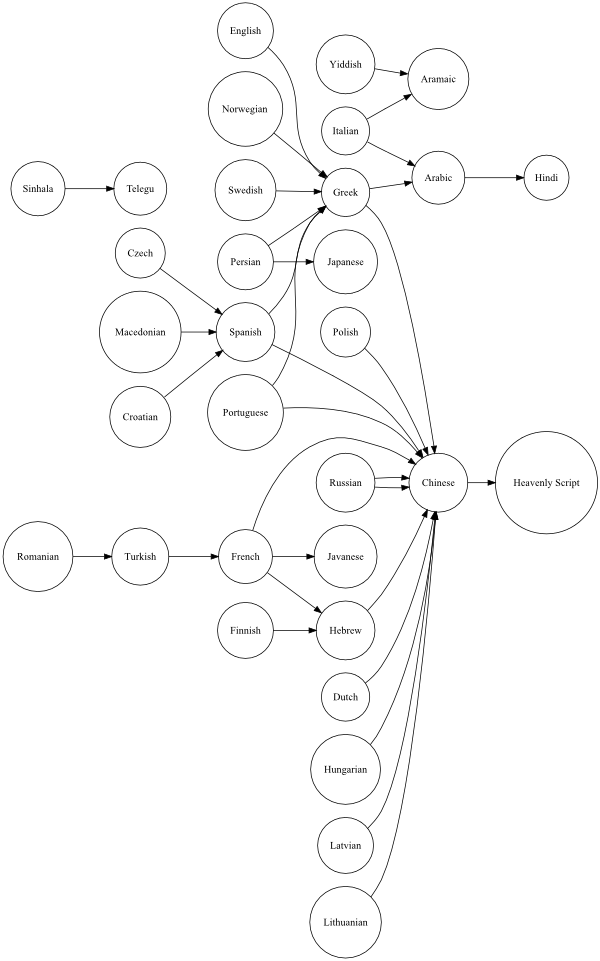
Language Log has put together this very interesting chart of incomprehensible languages. In English, our idiom references Greek as the stereotypical incomprehensible language, but many other languages might say it sounds like Hebrew, like Chinese, or even like Spanish.

Check it out: The directed graph of stereotypical incomprehensibility

(Thanks, Steve!)

Wednesday, February 25, 2009

Neubau

The NY Times takes on Wien's hip and trendy seventh district: Vienna's Neu-Wave Corner

Tuesday, February 24, 2009

Happy Rosenmontag!


Hope you had a wonderfully bawdy Rosenmontag. Happy Mardi Gras tomorrow!

The Musical is Back!

One last note on the Oscars 2009. As a bit of a theater geek myself, I was thrilled to hear about Hugh Jackman and Beyonce Knowles musical performance last night at the Oscars. If you have not seen it, definitely check out this Broadway tribute/montage below:


Also, here's Hugh Jackman's opening song as host. (Compare with Billy Crystal's popular opening video in 2004). Congratulations to all the winners!

Sunday, February 22, 2009

Sunday procrastinations

Thought this was appropriate for a Sunday afternoon, as students around the country struggle through piles of assignments, papers, and homework for the upcoming week. A friend provided this link, and the tune is so catchy that I couldn't help sharing.

I don't want to work either.

Saturday, February 21, 2009

The Obligatory Oscars Post

The Academy Awards Ceremony is this Sunday (ironically this year only a few days after Wien's own red-carpet ceremony, the Opernball). Everyone has been blogging about the nominations, their favorites, and their speculations. See A.O. Scott or David Carr "The Carpetbagger" for more details. In regards to the top award, the nominees are as follows:

Best Motion Picture:
“The Curious Case of Benjamin Button” (Paramount and Warner Bros.)
“Frost/Nixon” (Universal)
“Milk” (Focus Features)
“The Reader” (The Weinstein Company)
“Slumdog Millionaire” (Fox Searchlight)


I have not yet seen "Frost/Nixon" or "The Reader", though I have heard great reactions to both. "Milk" was phenomenal, and I would be content if they snagged the top prize. Sean Penn's performance certainly deserves an Oscar for Best Actor.

But I admit, I was rather surprised to see "Benjamin Button" receiving a top nod. Don't get me wrong, it was a very nice movie, but I left the theater with the feeling that it had all been done before. Funny or Die captures my sentiments best: The Curious Case of Forrest Gump (Thanks for this link, Kodachrome Quixote!). Also, I was not very impressed with Brad Pitt. And it was a bit too long and not at all related to the Fitzgerald short story. All in all, it wasn't a bad movie, but Best Picture caliber? Really?! And with 13 nods, being offered the most nominations?!

I admit, along with most of the Hollywood community, I am enamored with Slumdog Millionaire. There's been a decent amount of controversy in India surrounding this film (here, here, and here for example), especially because of its use of the derogatory "slumdog" in the title and its portrayal of slum life. Today's NYT featured opinion piece provide fascinating insights into Dharavi, the "slum" near Mumbai that was used in the filming. According to their editorial, Dharavi is a safe, resourceful, and incredibly industrious city. Others are offended by the slang of "dog", but as Chitra Divakaruni points out, most of those employing this critique have probably not seen the movie. "Slumdog" is never a term used to refer to all the slum dwellers, but instead only spoken in specific instances by characters who play an antagonistic role opposite our hero, Jamal. Others feel that the movie heaped on too much of the extremes, including everything possibly bad and horrific to be solved by a material goal--in the words of Jamie Rhein, piling "on bad news in huge helpings with only one solution to address the mess--win gobs of money and get the girl."

These are all valid critiques, and yet I still strongly support "Slumdog Millionaire" for Best Picture. Unlike every other film on the list as far as I am aware, "Slumdog Millionaire" takes us to a world that would be unfamiliar to most everyday American viewers. There are no big-name American stars or faces that we recognize, yet we are drawn into this story and relate with the characters. This is not a documentary, and of course it is not entirely factual--the extremes must be taken with a grain of salt. Yet it is a beautifully painted fairy tale and might serve in a small way to push everyday viewers beyond their comfort zone, to gain a glimpse of a beautiful and unfamiliar culture that is different from their own, and yet the same so many ways.

Friday, February 20, 2009

New Layout?

For anyone who's been paying attention, any thoughts on the new layout? My HTML skills are limited, so I couldn't be too fancy, but I wanted to add a personalized banner. I'm picky, so it took me a while to decide on a new template. Like it? Hate it?

The picture is mine, taken from the castle in Ljubljana, Slovenia in February 2008.

Sunday, February 15, 2009

Kindle 2: Not Yet the New iPod

As anyone who has recently visited the Amazon home page can tell you, the second generation Amazon Kindle has been announced. For the most part, this e-book reader seems pretty similar to the first, with tweaks to the software, a sleeker design, and text-to-speech capabilities.

But as the Economist points out, the Kindle is not yet the "new iPod" as Amazon hopes. Instead, it is a device for passionate readers (it can hold up to 1,500 books) and those who want the convenience of being able to purchase and read a new title in a matter of seconds. I've seen a few of these devices on the subways on New York City, held by professionals on their long commutes rather than carrying multiple (heavier) printed books. Publishing professionals long for the day when the Kindle or a similar e-book reader could be a manuscript reader (or is it already?), to make it easier to wade through the hundreds of heavy pages of solicited submissions. (Forget the slush pile).

However, in the end, I really don't see the Kindle having mass appeal just yet. Amazon has been very closed about their sales figures, so no one really knows how popular the Kindle really is. But they have been promoting their device like crazy, calling it a "revolutionary wireless reading device". I don't know about revolutionary, just maybe the most well-known and well-funded. There have been many e-book readers before, so it was bound to happen that a stronger company would undertake the challenge. All in all, it seems to be a rather conservative device and pretty much what one would expect from an e-book reader.

What comes next? I really don't see any e-book reader replacing the comfort of curling up with a printed book any time soon, but it is a convenience if you need to read (and carry) a lot of books around. Perhaps if the Kindle is able to add highlighting capabilities, it will make great strides in the arena of scholarly books, appealing to students who are tried to purchasing hundreds of dollars worth of textbooks that they rarely use. Or perhaps I'm wrong, and with all this publicity and the huge push behind the device, consumers will decide that it really is popular and buy it for themselves.

Personally, I'm waiting to see if Apple will have a rebuttal for this new leap in technology. They've already enabled the iPhones to download and read public domain books for free. Will they unveil a separate device, the iRead perhaps, to really revolutionize the field?

Friday, February 6, 2009

Alles Gute zum Geburtstag, Jakov Lind

We have a special birthday to celebrate today. Jakov Lind, lauded as one of the greatest contemporary German writers during his day, would be 82 today. In German-speaking lands he's right up there with Günther Grass and Thomas Bernhard as one of the best of the best. However, nowadays this great writer has drifted to become an international unknown, as his German pieces are virtually unavailable in English-speaking countries. (Thank goodness for Open Letter! They will be publishing a paperback translation of his Landscape in Concrete next month).

Jakov Lind, the name inscribed below these great works of fiction, lived a fascinating life of many names and languages. He was born to an Austrian-Jewish family as Heinz Landwirth, but escaped to the Netherlands in 1938 and took on the name Jan Gerrit Overbeek. He actually spent most of the war in Germany, hiding in full view as a Dutch laborer. After the war, he became Jakov Chaklan and lived briefly in Palestine. Returning to Vienna and finding his birth-city still overrun with Nazis, the man instead went to London and there began to write at last. Though many of his works are in German, he struggled greatly with his mother tongue, considering it a murderer's language. Later he mastered English and published works in this his fourth language; thus he is sometimes considered a British writer.

His writing style reflects his tumultuous, wandering life. Often compared to Kafka, Lind successfully pulls the reader into a wild and crazy adventure, but you can never quite trust his narration, his characters' biased perspectives, or know what is truly going on. In Landscape in Concrete, there is a sense that the end comes full circle with the beginning--Bachmann is still wandering, still alone, and still looking for his regiment. So much has happened in the pages in between, but readers feel a sense of symmetry and frustration, completeness and fragmentation, insufficiency and clarity. Definitely worth the read.

There are many treasures that have fallen through the cracks thanks to the ruthless advance of time, but Jakov Lind is one of the gems glittering between the floorboards.

Wednesday, February 4, 2009

The Day the Music Died

In memoriam: Fifty years ago today , the small plane that was carrying Buddy Holly, Ritchie Valens, and J.P. "The Big Bopper" Richardson crashed in rural Iowa. Don McLean later immortalized this loss of some of rock 'n' roll's brightest stars as "The Day the Music Died".


And the three men I admire most:
The father, son, and the holy ghost,
They caught the last train for the coast
The day the music died.

Friday, January 30, 2009

Terrible Towels for Superbowl XLIII

It's time for the Superbowl! (Yes, this is a pro-Steelers blog. Sorry Cardinals/Patriots/Browns/etc fans)

In about four hours, the Pittburgh Steelers and Arizona Cardinals will kickoff for this championship game of American football. Fans are cheering on their team or placing bets as to whether the underdog Cardinals will be able to top the boys from Pittsburgh, who will break records to hold the most Superbowl titles in history (6) if they win.

Normally, I don't follow American football closely, at least not during the regular season. (Give me European football any day). However, the Playoffs are a different story. And the Steelers' Playoffs is something different all together.

I can't claim to have ever lived in Pittsburgh, but I'm proud to be part of a large diaspora of Steelers' fans around the globe. This article, recently published by the Times, made me even prouder of my team: The Legacy Behind the Terrible Towels.

One of my biggest complaints about professional sports is the absurd salaries of the players and how it often becomes all about money. But when Myron Cope first suggested the Towel, he didn't envision some grand marketing scheme. Instead, he encouraged the everyday blue-collar workers of his city to just bring out a dish towel or whatever they had to wave and support their team. Even with the success of the golden towel, Cope put the proceeds to good use, donating every cent it earns. What a refreshing reminder, especially during this current recession.

Enjoy this great American holiday of pizza, wings, and the best commercials of the year. May the best team win!

Saturday, January 24, 2009

Book Trailers and More

Since the dawn of the internet, or since internet access became commonplace to the masses, publisher's have been struggling to reinvent their products. Books must now compete with the television, video games, movies, and now the internet as forms of entertainment. Many doomsayers have called the internet the end of the printed book. But publisher's have responded, working hard to integrate web sites and online entertainment with their ink-and-paper products.

Found this essay on The Times today, as a decent introduction to some of the latest initiatives in the publishing industry to "save the book".
See the Web Site, Buy the Book

EDIT: Here's another-- This article, from TIME, illustrates a lot of the ideas that I've been waiting to express and goes even further for some interesting possibilities. Not sure I agree with it all, but here you go. "Books Gone Wild: The Digital Age Reshapes Literature"

Friday, January 16, 2009

Dave Barry's 2008 in Review

Why did I not find this sooner?

Yep, behind the times on this one. But in case you haven't read it yet, check out Dave Barry's annual Year in Review, also known as Bailing Out of 2008.

Enjoy.

Thursday, January 15, 2009

Vienna's Ball Season

Well, it's been a while since I posted and officially a year since I left for Vienna, Austria. However, my reminiscences and reflections on the city won't be abating any time soon, and here's a long post to make up for it.

Christmas is over, the New Year is in full swing, and the Balls have begun in Vienna. Ball Season officially begins each year with the Kaiserball on Dec 31 and continues through the Fasching season until Ash Wednesday. Fasching, known elsewhere as Carnival, is a period of celebration and indulgence before the somber time of Lent. The Carnival celebrations in many cities culminate with the days just before Ash Wednesday, such as Rosenmontag in Köln and Mardi Gras/Fat Tuesday in New Orleans and the Caribbean. Vienna's celebrations stretch through the months of January and February, hosting hundreds of balls, each unique with their special name, dress code, invitees, etc.

The tradition of Ball Season is usually traced back to Austria's beloved Empress Maria Theresa. Famous for her reforms, she observed the wild debauchery during Fasching and resolved that her imperial city would not participate in such vulgarity. She banned the wearing of masks in the streets of Vienna, though she permitted the upper class to have masked parties in their homes. Her son Josef II later extended this privilege to the masses, and masked balls became a popular yearly tradition. This article presents a bit more of a detailed history of the progression to the modern balls (who knew that the waltz was once considered obscene?). Today, very few balls are actually masked, and the waltz is a staple component.

The balls range from elegant celebrations for students and universities to extravagant and exclusive (and expensive!) festivities hosted by specific groups. Many of the balls are open to anyone, provided that you can afford the cost of the ticket (ranging from 20€ to 1000€). Most are held in the Hofburg (the Habsburg's winter palace in the first district), but others are held in the Rathaus or Musikverein. There's the Flower Ball, the Ball of Army Officers, the Pharmacists' Ball, the Russian Ball, and even the Kaffeesiederball (Ball of the Viennese Coffee House Owners). The Rudolfina-Redoute is a masked ball, held on the last Monday of Fasching, whereas dancers attend the Hunter's Ball in Austrian ethnic costume, dirndls and lederhosen galore. The Lawyers' Ball is respected as one of the oldest, always held on the last Saturday, and the Opera Ball (on the last Thursday of Fasching) as one of the most extravagant (complete with televised red carpet gown-critique akin to the Oscars). Here's a full List of the 2009 Balls (pdf), with date, cost, and location.


Nope, there are no mirrors in this room. Those are all chandeliers.

I attended the 2008 Ball der Technik, aka the "TU-Ball", in the Hofburg Palace on the same night as the famous Opernball. (We passed a number of other gowns on the subway, many of whom were headed to Karlsplatz, the central subway stop in front of the Opera). Though the ball was officially sponsored by the Technical University, there were guests of all ages, not necessarily with any direct association to the university. There were at least 50 people from my program, with more than a thousand present over all--all ages, all dancing. I've never seen anything like it.

The main ballroom was mostly devoted to the waltz, with a full orchestra playing much of the night (a small jazz band would relieve them every few hours and play foxtrots and boogie woogies instead). Boothed tables on elevated platforms lined the ballroom's walls for the honored guests. Everyone else had to find their tables in a maze of rooms around the main ballroom--the Habsburgs built a very extensive chain of rooms; they just keep going and going, and there is always another room of tables somewhere ahead. Additionally, there are smaller ballrooms and other dance venues throughout this maze. A swing band was playing in what I like to call the Chandelier Room (above), another jazz band played in an adjoining room further in the maze, and across from the coatroom downstairs there was even a modernized room made to look like a club playing techno and hip hop.

However, before any dancing started in any room, first the debutantes were given the floor. This is an Austrian tradition that is upheld at any ball that you might attend. Young women and men, attending their first ball, prepare for this moment months in advance as they take dance lessons at any number of ballroom schools throughout Wien. On the night of their ball, they don long white gowns and gloves or black tuxedos and enter the ballroom in a polonaise procession. The first dance, a waltz, belongs to these young people. However, the main ballroom is usually packed with onlookers trying to catch a glimpse of this elaborate ceremony, so arrive early and pick a good spot or you will be unable to see or even get into the room--there are thousands of people attending, remember? The picture below, taken shortly after the debutante's waltz, is borrowed from a friend of mine who was able to get into the main ballroom; note all the lovely white gowns. After the debutantes have waltz (and often are congratulated with applause), the dance master calls "Alles Walzer!" and the dance floors are open to everyone. (It was only after this point that I was actually able to make it inside the main ballroom, due to dispersing crowds).


Dancing continues throughout the night, without noticeable pause. Generally, the etiquette is that the gentlemen are expected to ask the ladies to dance, and ladies should not casually decline. However, sometimes an hour is designated "Ladies' Choice", during which the roles are reversed; for this hour, only the women can ask the men for a dance, and the men (if they are indeed gentlemen) should accept. At the TU-Ball, I believe that this hour began at 1am. In order to accommodate a Line of Dance, slower dancers should always stay to the center of the ballroom, while faster couples dance the perimeter in a counter-clockwise direction. Here are some more guidelines for Ball Etiquette.

However, my favorite part of the night was at midnight. With the stroke of 12, the regular dancing stopped and all the guests flooded into the Grand Ballroom for the quadrille. (This time I had advance notice, so I was able to secure a good spot to watch). Dancers line up beside one another, alternating male-female. Each dancer faces his/her partner (who is in the opposite line) with about six feet of space between them. These long rows of dancers stretch from one end of the ballroom to the other.

The orchestra strikes up the chords to the Fledermaus Quadrille, an energetic six-movement piece from Johann Strauss' operetta Die Fledermaus (though usually not all the movements are performed). The steps are complicated, so the Dance Master calls out each step from the stage and demonstrates, such as spinning once with the person to your right, to your left, with your partner across from you, etc. At certain points, couples at the end of the rows dance a galloping dash through the tunnel-like passage between the rows of dancers; but these rows are so long that the dash to the other end takes dancers to the far side of the huge room! During a later movement, I recall some lyrics that everyone shouted in time, but I was unable to make out what was said. This traditional midnight quadrille, a cornerstone of any Viennese ball, is often a situation of laughter, chaos, and just sheer fun.

Immediately after the quadrille, the Galop begins. This country dance also dates to the 19th century. Dancers grab their partners and chassé wildly in a counter-clockwise direction around the room. The dance master will call "Reverse!" and the entire room must quickly change direction. This patterns continues a few times, and then "Tunnel!" is called. Couples form long rows again, and couples on the end (by the orchestra) galop through quickly, most likely laughing the whole time.


Dance Master and helpers demonstrating the quadrille

Shortly after the midnight's break, the orchestra resumed it's waltzes with the most famous of all--Strauss' "Blue Danube". The floor was so crowded for this song that even those that did know how to waltz could not properly move. Yet still, it was an amazing experience--waltzing to "The Blue Danube" in Vienna at an authentic Viennese Ball! It made all the stubbed toes worth it.

Viennese balls do not end until almost dawn; however, a number of the guests left shortly after "The Blue Danube". Sadly, I was among them, due to the need to sleep before an exam the next morning. On the way out, as per tradition, all the ladies were given a Damenspende. This gift for the ladies is like a party favor. It might be a simple piece of jewelry, a waltzing CD, or something similarly small and simple; the TU-ball gifted a baked good, some sort of chocolate gingerbread cake in nice wrappings.

I missed out on only one Viennese Ball tradition (that I am aware of)--the Katerfrühstück, the junk food breakfast afterwards. Most young people dance the night away until the ball ends around 5am; then, walking home in gowns, heels, and tails, they stop for food at the only places that are open--the Imbiss stands. Many of these fast food counters are open 24 hours, providing pizza, kebab, and wurst to any late night (or early morning) wanderer, regardless of their formal garb.

Overall, what an incredible experience. If you are ever in Vienna during January or February, be sure to bring a gown or suit. Here's what the NY Times has to say. I rank the experience of going to an authentic Viennese ball up there with the other grand travel To Do's of Life: See the Taj Mahal. Be in NYC's Times Square for New Years. Go to Rome for Easter. Attend a Ball in Vienna and dance the night away.

Wars with Rockets and with Oil

A couple of interesting articles from today's Times.

Why Israel Can't Make Peace with Hamas: An opinion piece which sheds some light on the complicated relationship between (Sunni) Hamas and (Shia) Hezbollah.

Gas Disputes Run Deeper than Pipes: Detailing the Gazprom tensions between Russia and Ukraine. This piece provides some good background on the weight of the issue for any readers that are less familiar with the situation. It's not really about the gas.

Disclaimer

The views expressed on these pages are solely belonging to the author and do not reflect the views of the Fulbright Program, the U.S. Department of State or its partner organizations.