Saturday, June 20, 2009

Go Remy Arlington Rap

Anyone who has lived in the DC area, especially in Arlington, will appreciate Remy's latest feat:


... at the Starbucks or the Starbucks or the Starbucks or the Starbucks...

Wednesday, June 17, 2009

June 16, 1989

First of all, as we can't be neglecting our literary dates, Happy Bloomsday!

Twenty years ago, June 16 proved to be the second step toward the fall of communism in Eastern Europe. Just days before in Poland, Solidarity had emerged victorious in the first free, democratic election in all of Eastern Europe. June 16, 1989, was a day of symbolism for Hungary, but this symbolism proved most powerful. On this date, the Hungarians performed a reburial--a reinterment of a man who was once regarded as a traitor, an enemy of the state, and perhaps even Hungary's most potent criminal against communism.

In 1953, the Hungarian Communist Party selected reform-minded Imre Nagy as their new Prime Minister, but he only lasted two years before falling out of favor. In October 1956, the people called for a change and students discontent with communism, led to the Hungarian Uprising. Amidst tumult and revolt, the people of Hungary called on Nagy as their revolutionary leader. Indeed, it is hard to understate the significance of the 1956 Hungarian Revolution; not only is it regarded as one of the proudest moments in Hungarian history, but it also marks the first major revolt against communism and the USSR--indeed, a revolution against the revolution. But in November, Soviet tanks invaded Hungary. Nagy was arrested and, along with other leaders of the revolution, executed and dishonorably interred.

Decades later, the Soviet Union was beginning to weaken, and a more flexible and reform-minded Hungary was passing legislation toward democracy. In May they had removed barbed wire from the borders with Austria, the first step toward opening borders with the West (!), and thus slowly tearing a hole in the Iron Curtain. In this spirit, on June 16 the grave of Nagy and his revolutionary comrades was opened, and they were honorably buried with pomp and respect. 250,000 people are estimated to have attended his reburial.

The Reinterment of Nagy was just another step away from the USSR and toward democratization. However, historians today consider this symbolic act as the keystone in Hungary's strides toward democracy in 1989; the symbolism became the strongest mark in their break with communism. Like Solidarity's election in Poland, Nagy's reburial marked the rise of a New Europe, encouraging and accelerating revolutionaries in neighboring Czechoslovakia and East Germany.

Some time after Nagy's reinterment, a statue was built to commemorate the leader. He is posed on a bridge, staring wistfully toward the Hungarian Parliament building. Twenty years after the event of his reinterment, Hungarians celebrated their hero and the change he wrought--both in life and in death.


Imre Nagy's statue looking toward the Hungarian Parliament (my photo, May 2008)

Monday, June 8, 2009

Praise for Latin

In the age when foreign languages are frequently being cut from school budgets, the argument often arises: What is the value of Latin? What's the point in teaching students a dead language that they will never be able to use?

In high school, I remember many academically-ambitious students solely choosing to study Latin as a means to improve their SAT scores. According to their argument, the study of Latin would make them more aware of the etymology behind word roots, and thus they would have a distinct advantage in the vocabulary section--even if they did not know the word, they could recognize the Latin roots to guess its meaning.

Though this may be true, students of French, Spanish, or German might not be far behind thanks to all the cognates and crossovers between the languages. However, I firmly believe that Latin has a much more meaningful value beyond improving test scores.

Unfortunately, I have not yet had the opportunity to learn Latin myself, but I am familiar with some of the cases and I am very aware of the disciplined work required of any Classics major and the complex struggle to create a short translation. The Guardian recently reported the reinstation of Latin by many British schools and offered Charlotte Higgins' view to praise its value. Latin not only teaches word roots and etymology, but it teaches discipline, grammar, and structure. Thus, Latin is not only relevant when learning another foreign language (and may be especially useful when learning a language with cases, like German), but it improves our understanding of the prescriptive rules of "proper" grammar in our own native English. Harry Mount most eloquently puts it in his masterful "Vote for Latin" from 2007.

In Vienna, I taught at a Gymnasium (high school equivalent) and worked with students who were learning English. For most students, English was just one of many languages that they were studying. Early in their studies (I believe around age 10), the students would select to study either English or Russian as their specialty and continue this study intensely at least until graduation (and the Matura exams) at age 18. Around age 12, all students started learning another language: Latin. From there students could continue by starting French, picking up the other specialty language (English/Russian), and taking electives in Spanish or Italian. Competency in multiple languages was crucial for an Austrian student, given the country's central position in Europe bordering so many different language groups. Thus, instruction with Latin is essential and provides the disciplined foundation for all future language learning and made learning the Romance languages much easier. (Indeed, older students would ask for Latin, rather than German, translations of English words in order to more fully understand the meaning).

In America, we're not surrounded by so many different languages, and thus our education's focus is not on foreign languages and certainly not on Latin. Don't get me wrong, I know that there are other important things to study and the mastery of any foreign language is very difficult. But I think we suffer because of our lack of respect for languages in education. We even blindly declare the dead language to be "useless". But Latin is not just a language for monuments, but a tongue for intellectualism and deeper thought, for instruction and comprehension, for developing discipline and devotion.

Friday, June 5, 2009

June 4, 1989

June 4 was a tumultuous date in 1989. The Ayatollah Khomeini of Iran, who led the Iranian Revolution ten years before to overthrow the Shah, died the day before; the funeral of this controversial figure was held on this date. Millions attended. Wikipedia informs me that June 4 was also the date that of an Ufa train disaster in Russia. In passing, two trains threw sparks at each other near a leaky natural gas pipeline; 645 people were killed in the resulting explosion.

In addition, two big events really mark this date as unique and significant--a date of celebration or infamy. First, if you have been following the news today, you will have seen on the front page, beside the news of Obama's speech in Cairo, the 20th Anniversary of the Tiananmen Square Massacre. (Missed it? Try this one, this one, Hong Kong's vigil, Beijing's silence, this collection of photos and commentary, and the photographer's perspective on returning 20 years later). In late May 1989, students began gathering in Beijing to protest corruption; however, these protests turned into a call for democracy, including a raising of the Goddess of Democracy. However, protests turned ugly when tanks rolled into the square. The army opened fire on June 4, and countless numbers of unarmed students were killed and injured in the massacre. Today, these anonymous protesters are remembered around the world as heroes for democracy, though controversy continues in China.


One of the most famous images of 1989 Tiananmen Square


Buried behind the headlines, you might have seen word of another remarkable anniversary: the 20th anniversary of Solidarity's victory in Poland in the polls. At first, this may not seem so remarkable, but consider that the pre-1989 world was divided into spheres--the Soviet spheres of influence and communist countries and the American spheres of influence and democratic countries. The Iron Curtain was not merely a metaphor, but a reality of life--there was no passage between East and West.

Yet on June 4 in Poland, a pro-Western and pro-democracy party (originally a labor union in Gdansk) achieved an incredible victory in one of the first legitimate elections held in the Eastern Bloc, thus marking a turning point in the entire course of European history. The success of Solidarity--which had struggled to exist for ten years, had been banned many times in Communist Poland, and was only legitimized again a few months prior to the election--was the first of many cracks in the rigid Iron Curtain. European leaders commemorated this turning-point today; in retrospect we can see that through this election, the Poles led the way in the anti-communist revolutions across Eastern Europe and the transition to democracy. And in Poland's case, this was all accomplished both legally through elections and peacefully without any loss of life.

Across the globe, June 4, 1989 was a date of cries for democracy and the beginning of change.


Solidarity founder (and later Polish president) Lech Wałęsa and Solidarity

Thursday, June 4, 2009

Twenty years ago

History is fickle and tends to repeat herself, but every now and again, a year comes along that really stands apart from the rest. Maybe that year was a time of momentous beginnings, of unheard of discoveries and great advances in human thought that marked a change in mankind's progression. Or maybe it was a year of endings, of collapsing empires, slaughter and destruction, and of mankind reformed as the phoenix rising from the rubble. Either way, during these remarkable years, when momentous unrelated world events happened simultaneously or one set off a ripple to cause many others, these years changed the course of history.

The twentieth century was a remarkable time. One could argue that we had a number of such years. 1968. 1945. 1918.

This year marks the twentieth anniversary of one of the most remarkable years: 1989, the year of the sudden collapse of communism, the opening of the Berlin Wall, and the massacred cry for democracy in Tiananmen Square. Artists are reflecting on the meaning of this year, Writers are submitting their anecdotes, and everyday people are offering their stories.

Here at Waltzing Matelda, I will do my part by offering a summation and reflection on the majors events of 1989 (culminating in the collapse of the Iron Curtain) on the date of their anniversary. Stay tuned for regular updates on this feature, and check the new label 1989 for a chronological list as they occur.

Wednesday, June 3, 2009

Next Up

I was tempted to write this like a bad movie trailer, but chickened out.

It's summer 2009, and this year Waltzing Matelda is taking on a new city--Washington, DC. Prepare for reviews, pictures, travel suggestions, and crazy observations in the US capital. And more likely than not, prepare for lots of comparisons to New York City and Vienna.

Catch you on the flip side.

Thursday, May 28, 2009

Introverted traveling

I tend to consider myself an "introvert with extrovert tendencies"(Myers-Briggs usually gives me an I rather than an E, but I'm borderline), so it was very interesting to consider how differences in personality affect how a person travels. (via kottke)

Roberto and Dante

Italian actor and comedian Roberto Benigni (also famous for his exuberance at the 1999 Oscars) brings his stand up Dante act (Tutto Dante, here in Italian) to the US. He begins by reciting a canto (from memory) and then humorously interpreting it to our modern day. (sound familiar?) He will be in the Hammerstein Ballroom in NYC this Saturday. Other cities on his eight show tour include Montreal, QC (two shows); Boston, MA; Toronto, ON; and and Quebec City, QC, before concluding on June 12 in Chicago, IL. (Review from the NY Times)

His words at a recent interview really encapsulate the power of Dante's Comedia, as one of the greatest works ever written: “We need to have the nerve to understand why a man with a big nose 700 years ago had the heroic shamelessness to write. Really this is the most daring, bold poetry ever. In 2,000 years of Christian poetry they never surpassed this. They never produced such a scandal of beauty. Never, never, nobody.”


Benigni recites the very beginning of the Comedia with the first lines of the Inferno.

Thursday, May 21, 2009

Tuesday, May 5, 2009

Tasty (or not so tasty) Books

For laughs: Bad Eating Makes for Good Reading

Why am I suddenly reminded of those elaborate feasts described in the Redwall novels that I read as a kid? (Always including deeper'n'ever pie, watershrimp, and elderberry wine of course!)

Monday, May 4, 2009

The Most Livable City in the World

Just this past week, Mercer officially granted Vienna the title of 2009 Best Quality of Living, passing Zurich from last year... in other words, Wien is *the* BEST city in the world in which to live! (More details of the study here).

Of course, anyone who has lived in this beautiful imperial city could tell you that. ^_^ To celebrate, here's a smattering of my photos of this "very livable" city:

Stephansdom and centercity Wien

one of Otto Wagner's old railway entrances

yellow

stadium

Naschmarkt2

strawberries

A Proper Introductory Post

Returning from my month-long hiatus, I think it best to start afresh; namely, after more than a year of postings, it's about time that I properly introduce this blog.

Waltzing Matelda began in January 2008 as a standard study abroad journal. Initially, I simply chronicled life abroad in Vienna, Austria. But the writer in me enjoyed the process so much that I wanted to do more than chronicle my story--I wanted to share the Austrian culture, landscape, and history as I experienced it. I wanted to provide a fresh perspective but also share what I had learned with those around the globe.

Since then, Waltzing Matelda has grown from a mere travel journal to encompass a whole range of other topics, including commentary on books, recipes, germanic (pop) culture, current events, and more. Rather than focusing only on one specific topic, I prefer to explore all my interests, providing varied and diverse reading and sharing a myriad of fascinating information.

Disclaimer: Many of the images on this blog exist thanks to the talents of others photographers or artists. Posts tagged with "photos" highlight some of my personal photographs. The banner's background is a personal photograph of Ljubljana, Slovenia.


What's in a name? A number of people have asked me about this. Yes, it is Matelda with an "e". The name may originate from the Australian national folk song, but the different spelling and the subtitle pay tribute to the travels of one Dante Alighieri, arguably one of the greatest travel writers. Even if his travels were fiction (don't tell that to Italians in the 14th century!).

What comes next? At its heart, Waltzing Matelda remains a travel journal, in that I am constantly exploring new places, topics, languages, books, and ways to expand my world-view. Whenever I travel to a new place, I attempt to provide a clear, unbiased perspective and chronicle interesting facts or things to do. My recent journeys have included living in the following cities:

Spring 2008: Vienna, Austria
Summer 2008: New York, New York, USA
Summer 2009: Washington, D.C., USA
August 2010-2011: Poznań, Poland

And traveling everywhere in between. What comes next, I can't say for certain. But that's part of the adventure.

“One’s destination is never a place, but a new way of seeing things.” - Henry Miller

Tuesday, March 31, 2009

Cleaning out Bookmarks

April is the cruelest month, so I might be entering a hiatus in the near future. Apologies for infrequent updates, but I'll be back as soon as possible.

For now:

Will the Real Slumdog Please Stand Up? An interesting piece about the actual man who remains the only one to win the grand prize of India's who wants to be a millionaire.

If Bernie Met Dante... As a lover of the Divine Comedy (can't you tell from my blog subtitle?), I was highly amused by this article. After all, Dante's "Who's Who of Hell" consisted of his own contemporaries, so why not update with a few of our own? If you like this idea of modernizing the timeless masterpiece, also check out this interpretation.

The Greak Geek-Off: Suvudu is hosting this contest to celebrate the recent publication of Garth Sundem's The Geek's Guide to World Domination. Test your skills and see if you can win. New trivia will be posted daily, so check Suvudu for the updated link of the day.


Finally, xkcd posted this comic recently. The bibliophile/art lover/literary dork could not help sharing. :)

Friday, March 20, 2009

Tonight, Esta Noche

The bi-lingual revival of West Side Story opened tonight. The Jets will retain many of their famous songs, but the Sharks will now be singing their same songs in their native tongue--Spanish. The NYT offered this interesting review of the show.


"The gangs in “West Side Story” shocked in 1957. Brooks Atkinson in The New York Times called their conduct “neurotic and savage,” with a code “rooted in ignorance and evil.” While writing the original book, Mr. Laurents said, he at times feared they would be too unsympathetic. Now he worried about the opposite problem: that those “savages” seemed too much like benign, lovable misfits... Because “West Side Story” deals with social change, previous revivals have been burdened with a comparison between what was happening onstage and what was happening on the street, and critics have complained that revivals have seemed dated."

Yet this revival is daring, offering a fresh perspective by really allowing language to distance the gangs for the first time, unsettling or perhaps touching closer to home for the audience. I'm fascinated and I can't wait to see it.

EDIT: The Times also now has this front-page review up. Enjoy!

Sunday, March 15, 2009

Asparagus Soup

One of my favorite things about Austrian cuisine is the focus on foods that are in season and using this produce for as many seasonal dishes as possible. In the early spring, we are now in asparagus season, and asparagus dishes will be all over Wien. I was craving some good Spargelsuppe, so I googled some recipes to make my own. Unfortunately, as a student lacking some key ingredients (cream), it did not turn out like the Viennese creamy version, but it was very tasty in its own right!

I modified this recipe and added/eliminated ingredients based on what I had available. I also chose not to puree my final product, so it was a very tasty chowder rather than a cream of asparagus soup.

INGREDIENTS
2 tablespoons butter
2 tablespoons olive oil
1 onion, chopped
2-3 cloves of garlic
(opt) 3 stalks celery, chopped
1/2 cup fresh mushrooms, diced
3 tablespoons all-purpose flour
1 (14 ounce) can condensed chicken broth
1 chicken bouillon cube
2 cans full of water (about 2 cups)
(opt) 1 potato, peeled and diced
1 pound fresh asparagus, trimmed and coarsely chopped
3/4 cup half-and-half (or milk)
1 tablespoon soy sauce
1/4 teaspoon ground black pepper
(opt) 1/4 teaspoon ground white pepper
approx. 1/4 teaspoon ground cloves
dash of ginger

1. Melt butter or margarine in a heavy cooking pot. Add olive oil. Add onions and chopped celery; after a few minutes, add diced mushrooms. Saute until tender. Press or thinly dice the garlic, as you prefer, and add to pot.

2. Stir in flour, mixing well. Cook for about 1 minute, stirring constantly. Do not burn, or let it go lumpy.

3. Add water, chicken broth, and chicken soup base; stir until smooth. Bring to a boil. Add diced potatoes and chopped asparagus. Reduce heat, and simmer for about 20 minutes. Drop a piece of old bread on the top of the soup to soak up any excess oils. Remove bread before next step.

4. (Ignore this step if you prefer a chowder-like soup rather than cream of asparagus). Puree soup in a food processor or blender in batches. Return to pot.

5. Stir in half and half (or milk for a thinner soup) and soy sauce. Add peppers, cloves, and ginger. Bring soup just to boil. Adjust seasonings to taste. Serve hot.


Though this was very tasty, I'm still looking for an authentic Austrian-style recipe. Might try this one next time: White Asparagus Soup.

Saturday, March 14, 2009

One Bizarre Advertising Campaign

No words for this one. Just go to the site, and click all the way through. Introducing the Pomegranate Phone

The Pomegranate phone is the ultimate all-in-one device. It puts more things in the palm of your hand than you ever thought possible: phone, email, full internet browsing, camera, video, MP3 player, GPS navigation.

Thursday, March 12, 2009

March Madness

In the spirit of March Madness, the fifth annual Tournament of Books is underway. The Morning News and Powell's sponsor this "tournament", with two books that were published in the past year facing off each day. So far, the winners from the first round are 2666, Netherland, and The White Tiger. Check out the standings (on the right) and check back daily to see who's winning. May the best book win!

In basketball news, a Brooklyn indie bookstore is starting a literary summer basketball league. However, only bibliophiles can join. Rather than trying out by shooting hoops, you try out by answering a set of questions, such as "Who wrote Ulysses?" and "What is J. D. Salinger’s most well-known book?". Be ready to analyze literature while dribbling.

Finally, if you know Philadelphia, check out Philly Lush's Philadelphia March Madness. Vote for your favorite places in the city and see if Mayor Nutter or the Philly Phanatic takes home the trophy.

Monday, March 9, 2009

A Writer's Haven in Paris


This writer and bibliophile is thrilled by the offer: writers in Paris can sleep at this historic bookshop for only one small cost--they must read a book a day.

During the 1920s, the famous patroness Sylvia Beach supported many aspiring writers in Paris by setting up cots between the shelves of her bookstore, Shakespeare and Company, and offering these penniless poets a place to sleep. Many great names frequented this shop, including Ernest Hemingway, Ezra Pound, T. S. Eliot, Thornton Wilder, Gertrude Stein, and James Joyce (Beach helped publish Ulysses, widely regarded as one of the greatest works in the world, when no one else would).

The current Shakespeare & Company (since 1962) continues Beach's tradition. Food and a bed are offered to writers, and their only rule or cost is that they must read one book every day. The Guardian recently visited the shop and wrote a great article about the unique bookstore. Down and Out in Paris: Revisiting Shakespeare and Company

Sounds like my kind of place. Definitely worth a visit when I finally make it to Paris.


A writer's cot among the shelves of Shakespeare & Co.


Check out the full list of some of the Most Interesting Bookstores of the World.

Friday, March 6, 2009

Extreme Group Bridge Jumping?

There's a new extreme sport in town, taking bungee jumping to the next level by adding a bridge, a solid river of ice, an oncoming train, and 20 of your closest friends:

English Russia >> Group Rope Jumping

More bridge photos at their source (here), but the site's in Russian.
(Credit for this find to kottke)

It's all Chinese to me!

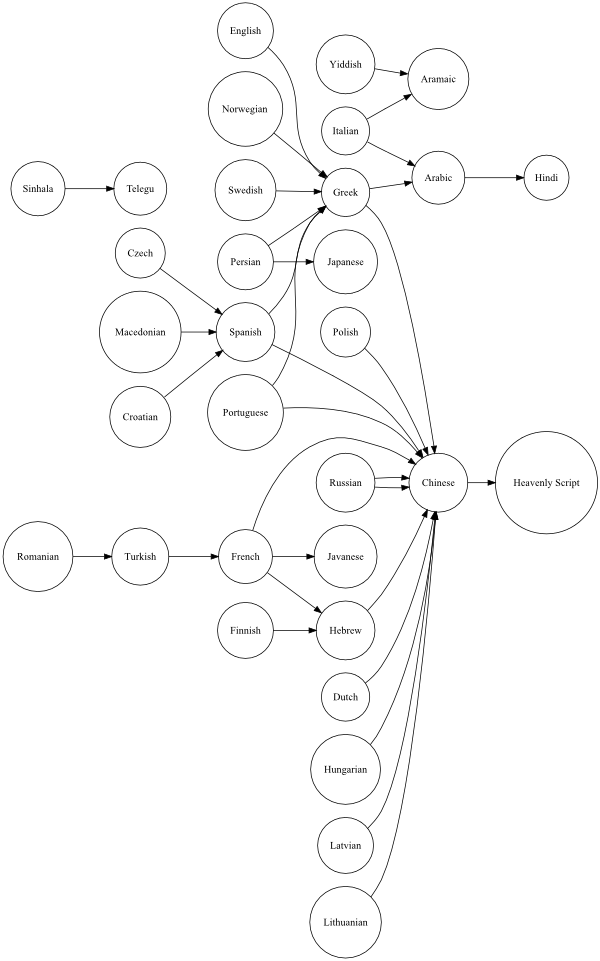
Language Log has put together this very interesting chart of incomprehensible languages. In English, our idiom references Greek as the stereotypical incomprehensible language, but many other languages might say it sounds like Hebrew, like Chinese, or even like Spanish.

Check it out: The directed graph of stereotypical incomprehensibility

(Thanks, Steve!)

Disclaimer

The views expressed on these pages are solely belonging to the author and do not reflect the views of the Fulbright Program, the U.S. Department of State or its partner organizations.