Tuesday, February 24, 2009

Happy Rosenmontag!


Hope you had a wonderfully bawdy Rosenmontag. Happy Mardi Gras tomorrow!

The Musical is Back!

One last note on the Oscars 2009. As a bit of a theater geek myself, I was thrilled to hear about Hugh Jackman and Beyonce Knowles musical performance last night at the Oscars. If you have not seen it, definitely check out this Broadway tribute/montage below:


Also, here's Hugh Jackman's opening song as host. (Compare with Billy Crystal's popular opening video in 2004). Congratulations to all the winners!

Sunday, February 22, 2009

Sunday procrastinations

Thought this was appropriate for a Sunday afternoon, as students around the country struggle through piles of assignments, papers, and homework for the upcoming week. A friend provided this link, and the tune is so catchy that I couldn't help sharing.

I don't want to work either.

Saturday, February 21, 2009

The Obligatory Oscars Post

The Academy Awards Ceremony is this Sunday (ironically this year only a few days after Wien's own red-carpet ceremony, the Opernball). Everyone has been blogging about the nominations, their favorites, and their speculations. See A.O. Scott or David Carr "The Carpetbagger" for more details. In regards to the top award, the nominees are as follows:

Best Motion Picture:
“The Curious Case of Benjamin Button” (Paramount and Warner Bros.)
“Frost/Nixon” (Universal)
“Milk” (Focus Features)
“The Reader” (The Weinstein Company)
“Slumdog Millionaire” (Fox Searchlight)


I have not yet seen "Frost/Nixon" or "The Reader", though I have heard great reactions to both. "Milk" was phenomenal, and I would be content if they snagged the top prize. Sean Penn's performance certainly deserves an Oscar for Best Actor.

But I admit, I was rather surprised to see "Benjamin Button" receiving a top nod. Don't get me wrong, it was a very nice movie, but I left the theater with the feeling that it had all been done before. Funny or Die captures my sentiments best: The Curious Case of Forrest Gump (Thanks for this link, Kodachrome Quixote!). Also, I was not very impressed with Brad Pitt. And it was a bit too long and not at all related to the Fitzgerald short story. All in all, it wasn't a bad movie, but Best Picture caliber? Really?! And with 13 nods, being offered the most nominations?!

I admit, along with most of the Hollywood community, I am enamored with Slumdog Millionaire. There's been a decent amount of controversy in India surrounding this film (here, here, and here for example), especially because of its use of the derogatory "slumdog" in the title and its portrayal of slum life. Today's NYT featured opinion piece provide fascinating insights into Dharavi, the "slum" near Mumbai that was used in the filming. According to their editorial, Dharavi is a safe, resourceful, and incredibly industrious city. Others are offended by the slang of "dog", but as Chitra Divakaruni points out, most of those employing this critique have probably not seen the movie. "Slumdog" is never a term used to refer to all the slum dwellers, but instead only spoken in specific instances by characters who play an antagonistic role opposite our hero, Jamal. Others feel that the movie heaped on too much of the extremes, including everything possibly bad and horrific to be solved by a material goal--in the words of Jamie Rhein, piling "on bad news in huge helpings with only one solution to address the mess--win gobs of money and get the girl."

These are all valid critiques, and yet I still strongly support "Slumdog Millionaire" for Best Picture. Unlike every other film on the list as far as I am aware, "Slumdog Millionaire" takes us to a world that would be unfamiliar to most everyday American viewers. There are no big-name American stars or faces that we recognize, yet we are drawn into this story and relate with the characters. This is not a documentary, and of course it is not entirely factual--the extremes must be taken with a grain of salt. Yet it is a beautifully painted fairy tale and might serve in a small way to push everyday viewers beyond their comfort zone, to gain a glimpse of a beautiful and unfamiliar culture that is different from their own, and yet the same so many ways.

Friday, February 20, 2009

New Layout?

For anyone who's been paying attention, any thoughts on the new layout? My HTML skills are limited, so I couldn't be too fancy, but I wanted to add a personalized banner. I'm picky, so it took me a while to decide on a new template. Like it? Hate it?

The picture is mine, taken from the castle in Ljubljana, Slovenia in February 2008.

Sunday, February 15, 2009

Kindle 2: Not Yet the New iPod

As anyone who has recently visited the Amazon home page can tell you, the second generation Amazon Kindle has been announced. For the most part, this e-book reader seems pretty similar to the first, with tweaks to the software, a sleeker design, and text-to-speech capabilities.

But as the Economist points out, the Kindle is not yet the "new iPod" as Amazon hopes. Instead, it is a device for passionate readers (it can hold up to 1,500 books) and those who want the convenience of being able to purchase and read a new title in a matter of seconds. I've seen a few of these devices on the subways on New York City, held by professionals on their long commutes rather than carrying multiple (heavier) printed books. Publishing professionals long for the day when the Kindle or a similar e-book reader could be a manuscript reader (or is it already?), to make it easier to wade through the hundreds of heavy pages of solicited submissions. (Forget the slush pile).

However, in the end, I really don't see the Kindle having mass appeal just yet. Amazon has been very closed about their sales figures, so no one really knows how popular the Kindle really is. But they have been promoting their device like crazy, calling it a "revolutionary wireless reading device". I don't know about revolutionary, just maybe the most well-known and well-funded. There have been many e-book readers before, so it was bound to happen that a stronger company would undertake the challenge. All in all, it seems to be a rather conservative device and pretty much what one would expect from an e-book reader.

What comes next? I really don't see any e-book reader replacing the comfort of curling up with a printed book any time soon, but it is a convenience if you need to read (and carry) a lot of books around. Perhaps if the Kindle is able to add highlighting capabilities, it will make great strides in the arena of scholarly books, appealing to students who are tried to purchasing hundreds of dollars worth of textbooks that they rarely use. Or perhaps I'm wrong, and with all this publicity and the huge push behind the device, consumers will decide that it really is popular and buy it for themselves.

Personally, I'm waiting to see if Apple will have a rebuttal for this new leap in technology. They've already enabled the iPhones to download and read public domain books for free. Will they unveil a separate device, the iRead perhaps, to really revolutionize the field?

Friday, February 6, 2009

Alles Gute zum Geburtstag, Jakov Lind

We have a special birthday to celebrate today. Jakov Lind, lauded as one of the greatest contemporary German writers during his day, would be 82 today. In German-speaking lands he's right up there with Günther Grass and Thomas Bernhard as one of the best of the best. However, nowadays this great writer has drifted to become an international unknown, as his German pieces are virtually unavailable in English-speaking countries. (Thank goodness for Open Letter! They will be publishing a paperback translation of his Landscape in Concrete next month).

Jakov Lind, the name inscribed below these great works of fiction, lived a fascinating life of many names and languages. He was born to an Austrian-Jewish family as Heinz Landwirth, but escaped to the Netherlands in 1938 and took on the name Jan Gerrit Overbeek. He actually spent most of the war in Germany, hiding in full view as a Dutch laborer. After the war, he became Jakov Chaklan and lived briefly in Palestine. Returning to Vienna and finding his birth-city still overrun with Nazis, the man instead went to London and there began to write at last. Though many of his works are in German, he struggled greatly with his mother tongue, considering it a murderer's language. Later he mastered English and published works in this his fourth language; thus he is sometimes considered a British writer.

His writing style reflects his tumultuous, wandering life. Often compared to Kafka, Lind successfully pulls the reader into a wild and crazy adventure, but you can never quite trust his narration, his characters' biased perspectives, or know what is truly going on. In Landscape in Concrete, there is a sense that the end comes full circle with the beginning--Bachmann is still wandering, still alone, and still looking for his regiment. So much has happened in the pages in between, but readers feel a sense of symmetry and frustration, completeness and fragmentation, insufficiency and clarity. Definitely worth the read.

There are many treasures that have fallen through the cracks thanks to the ruthless advance of time, but Jakov Lind is one of the gems glittering between the floorboards.

Wednesday, February 4, 2009

The Day the Music Died

In memoriam: Fifty years ago today , the small plane that was carrying Buddy Holly, Ritchie Valens, and J.P. "The Big Bopper" Richardson crashed in rural Iowa. Don McLean later immortalized this loss of some of rock 'n' roll's brightest stars as "The Day the Music Died".


And the three men I admire most:
The father, son, and the holy ghost,
They caught the last train for the coast
The day the music died.

Friday, January 30, 2009

Terrible Towels for Superbowl XLIII

It's time for the Superbowl! (Yes, this is a pro-Steelers blog. Sorry Cardinals/Patriots/Browns/etc fans)

In about four hours, the Pittburgh Steelers and Arizona Cardinals will kickoff for this championship game of American football. Fans are cheering on their team or placing bets as to whether the underdog Cardinals will be able to top the boys from Pittsburgh, who will break records to hold the most Superbowl titles in history (6) if they win.

Normally, I don't follow American football closely, at least not during the regular season. (Give me European football any day). However, the Playoffs are a different story. And the Steelers' Playoffs is something different all together.

I can't claim to have ever lived in Pittsburgh, but I'm proud to be part of a large diaspora of Steelers' fans around the globe. This article, recently published by the Times, made me even prouder of my team: The Legacy Behind the Terrible Towels.

One of my biggest complaints about professional sports is the absurd salaries of the players and how it often becomes all about money. But when Myron Cope first suggested the Towel, he didn't envision some grand marketing scheme. Instead, he encouraged the everyday blue-collar workers of his city to just bring out a dish towel or whatever they had to wave and support their team. Even with the success of the golden towel, Cope put the proceeds to good use, donating every cent it earns. What a refreshing reminder, especially during this current recession.

Enjoy this great American holiday of pizza, wings, and the best commercials of the year. May the best team win!

Saturday, January 24, 2009

Book Trailers and More

Since the dawn of the internet, or since internet access became commonplace to the masses, publisher's have been struggling to reinvent their products. Books must now compete with the television, video games, movies, and now the internet as forms of entertainment. Many doomsayers have called the internet the end of the printed book. But publisher's have responded, working hard to integrate web sites and online entertainment with their ink-and-paper products.

Found this essay on The Times today, as a decent introduction to some of the latest initiatives in the publishing industry to "save the book".
See the Web Site, Buy the Book

EDIT: Here's another-- This article, from TIME, illustrates a lot of the ideas that I've been waiting to express and goes even further for some interesting possibilities. Not sure I agree with it all, but here you go. "Books Gone Wild: The Digital Age Reshapes Literature"

Friday, January 16, 2009

Dave Barry's 2008 in Review

Why did I not find this sooner?

Yep, behind the times on this one. But in case you haven't read it yet, check out Dave Barry's annual Year in Review, also known as Bailing Out of 2008.

Enjoy.

Thursday, January 15, 2009

Vienna's Ball Season

Well, it's been a while since I posted and officially a year since I left for Vienna, Austria. However, my reminiscences and reflections on the city won't be abating any time soon, and here's a long post to make up for it.

Christmas is over, the New Year is in full swing, and the Balls have begun in Vienna. Ball Season officially begins each year with the Kaiserball on Dec 31 and continues through the Fasching season until Ash Wednesday. Fasching, known elsewhere as Carnival, is a period of celebration and indulgence before the somber time of Lent. The Carnival celebrations in many cities culminate with the days just before Ash Wednesday, such as Rosenmontag in Köln and Mardi Gras/Fat Tuesday in New Orleans and the Caribbean. Vienna's celebrations stretch through the months of January and February, hosting hundreds of balls, each unique with their special name, dress code, invitees, etc.

The tradition of Ball Season is usually traced back to Austria's beloved Empress Maria Theresa. Famous for her reforms, she observed the wild debauchery during Fasching and resolved that her imperial city would not participate in such vulgarity. She banned the wearing of masks in the streets of Vienna, though she permitted the upper class to have masked parties in their homes. Her son Josef II later extended this privilege to the masses, and masked balls became a popular yearly tradition. This article presents a bit more of a detailed history of the progression to the modern balls (who knew that the waltz was once considered obscene?). Today, very few balls are actually masked, and the waltz is a staple component.

The balls range from elegant celebrations for students and universities to extravagant and exclusive (and expensive!) festivities hosted by specific groups. Many of the balls are open to anyone, provided that you can afford the cost of the ticket (ranging from 20€ to 1000€). Most are held in the Hofburg (the Habsburg's winter palace in the first district), but others are held in the Rathaus or Musikverein. There's the Flower Ball, the Ball of Army Officers, the Pharmacists' Ball, the Russian Ball, and even the Kaffeesiederball (Ball of the Viennese Coffee House Owners). The Rudolfina-Redoute is a masked ball, held on the last Monday of Fasching, whereas dancers attend the Hunter's Ball in Austrian ethnic costume, dirndls and lederhosen galore. The Lawyers' Ball is respected as one of the oldest, always held on the last Saturday, and the Opera Ball (on the last Thursday of Fasching) as one of the most extravagant (complete with televised red carpet gown-critique akin to the Oscars). Here's a full List of the 2009 Balls (pdf), with date, cost, and location.


Nope, there are no mirrors in this room. Those are all chandeliers.

I attended the 2008 Ball der Technik, aka the "TU-Ball", in the Hofburg Palace on the same night as the famous Opernball. (We passed a number of other gowns on the subway, many of whom were headed to Karlsplatz, the central subway stop in front of the Opera). Though the ball was officially sponsored by the Technical University, there were guests of all ages, not necessarily with any direct association to the university. There were at least 50 people from my program, with more than a thousand present over all--all ages, all dancing. I've never seen anything like it.

The main ballroom was mostly devoted to the waltz, with a full orchestra playing much of the night (a small jazz band would relieve them every few hours and play foxtrots and boogie woogies instead). Boothed tables on elevated platforms lined the ballroom's walls for the honored guests. Everyone else had to find their tables in a maze of rooms around the main ballroom--the Habsburgs built a very extensive chain of rooms; they just keep going and going, and there is always another room of tables somewhere ahead. Additionally, there are smaller ballrooms and other dance venues throughout this maze. A swing band was playing in what I like to call the Chandelier Room (above), another jazz band played in an adjoining room further in the maze, and across from the coatroom downstairs there was even a modernized room made to look like a club playing techno and hip hop.

However, before any dancing started in any room, first the debutantes were given the floor. This is an Austrian tradition that is upheld at any ball that you might attend. Young women and men, attending their first ball, prepare for this moment months in advance as they take dance lessons at any number of ballroom schools throughout Wien. On the night of their ball, they don long white gowns and gloves or black tuxedos and enter the ballroom in a polonaise procession. The first dance, a waltz, belongs to these young people. However, the main ballroom is usually packed with onlookers trying to catch a glimpse of this elaborate ceremony, so arrive early and pick a good spot or you will be unable to see or even get into the room--there are thousands of people attending, remember? The picture below, taken shortly after the debutante's waltz, is borrowed from a friend of mine who was able to get into the main ballroom; note all the lovely white gowns. After the debutantes have waltz (and often are congratulated with applause), the dance master calls "Alles Walzer!" and the dance floors are open to everyone. (It was only after this point that I was actually able to make it inside the main ballroom, due to dispersing crowds).


Dancing continues throughout the night, without noticeable pause. Generally, the etiquette is that the gentlemen are expected to ask the ladies to dance, and ladies should not casually decline. However, sometimes an hour is designated "Ladies' Choice", during which the roles are reversed; for this hour, only the women can ask the men for a dance, and the men (if they are indeed gentlemen) should accept. At the TU-Ball, I believe that this hour began at 1am. In order to accommodate a Line of Dance, slower dancers should always stay to the center of the ballroom, while faster couples dance the perimeter in a counter-clockwise direction. Here are some more guidelines for Ball Etiquette.

However, my favorite part of the night was at midnight. With the stroke of 12, the regular dancing stopped and all the guests flooded into the Grand Ballroom for the quadrille. (This time I had advance notice, so I was able to secure a good spot to watch). Dancers line up beside one another, alternating male-female. Each dancer faces his/her partner (who is in the opposite line) with about six feet of space between them. These long rows of dancers stretch from one end of the ballroom to the other.

The orchestra strikes up the chords to the Fledermaus Quadrille, an energetic six-movement piece from Johann Strauss' operetta Die Fledermaus (though usually not all the movements are performed). The steps are complicated, so the Dance Master calls out each step from the stage and demonstrates, such as spinning once with the person to your right, to your left, with your partner across from you, etc. At certain points, couples at the end of the rows dance a galloping dash through the tunnel-like passage between the rows of dancers; but these rows are so long that the dash to the other end takes dancers to the far side of the huge room! During a later movement, I recall some lyrics that everyone shouted in time, but I was unable to make out what was said. This traditional midnight quadrille, a cornerstone of any Viennese ball, is often a situation of laughter, chaos, and just sheer fun.

Immediately after the quadrille, the Galop begins. This country dance also dates to the 19th century. Dancers grab their partners and chassé wildly in a counter-clockwise direction around the room. The dance master will call "Reverse!" and the entire room must quickly change direction. This patterns continues a few times, and then "Tunnel!" is called. Couples form long rows again, and couples on the end (by the orchestra) galop through quickly, most likely laughing the whole time.


Dance Master and helpers demonstrating the quadrille

Shortly after the midnight's break, the orchestra resumed it's waltzes with the most famous of all--Strauss' "Blue Danube". The floor was so crowded for this song that even those that did know how to waltz could not properly move. Yet still, it was an amazing experience--waltzing to "The Blue Danube" in Vienna at an authentic Viennese Ball! It made all the stubbed toes worth it.

Viennese balls do not end until almost dawn; however, a number of the guests left shortly after "The Blue Danube". Sadly, I was among them, due to the need to sleep before an exam the next morning. On the way out, as per tradition, all the ladies were given a Damenspende. This gift for the ladies is like a party favor. It might be a simple piece of jewelry, a waltzing CD, or something similarly small and simple; the TU-ball gifted a baked good, some sort of chocolate gingerbread cake in nice wrappings.

I missed out on only one Viennese Ball tradition (that I am aware of)--the Katerfrühstück, the junk food breakfast afterwards. Most young people dance the night away until the ball ends around 5am; then, walking home in gowns, heels, and tails, they stop for food at the only places that are open--the Imbiss stands. Many of these fast food counters are open 24 hours, providing pizza, kebab, and wurst to any late night (or early morning) wanderer, regardless of their formal garb.

Overall, what an incredible experience. If you are ever in Vienna during January or February, be sure to bring a gown or suit. Here's what the NY Times has to say. I rank the experience of going to an authentic Viennese ball up there with the other grand travel To Do's of Life: See the Taj Mahal. Be in NYC's Times Square for New Years. Go to Rome for Easter. Attend a Ball in Vienna and dance the night away.

Wars with Rockets and with Oil

A couple of interesting articles from today's Times.

Why Israel Can't Make Peace with Hamas: An opinion piece which sheds some light on the complicated relationship between (Sunni) Hamas and (Shia) Hezbollah.

Gas Disputes Run Deeper than Pipes: Detailing the Gazprom tensions between Russia and Ukraine. This piece provides some good background on the weight of the issue for any readers that are less familiar with the situation. It's not really about the gas.

Saturday, December 13, 2008

Technology

I'm ready for DVDs to be outdated technology.

I was kind of sad to see VHSes go back in the day (all of my favorite movies as a kid were on a VHS), but I quickly adjusted to the convenience of a DVD. Multiple DVDs can easily be transported (i.e. in a CD case rather than in their boxes). DVDs can be played by a personal computer, so a DVD player or TV screen was unnecessary.

DVDs have been mainstream for about the past 10 years. However, DVDs are even more fragile that VHSes were. I'm tired of renting a movie only to find that it skips because of a smudge or scratch, and thus I miss some crucial scenes of the film. Or, I hate looking forward to watching a movie that I own, only to take it out of its case and discover that it has a hairline crack and is now completely unreadable. There goes another $15. I guess that's one way to stimulate the economy--just keep making things breakable so that people keep buying.

I'm ready for the next big technological advancement, replacing DVDs with something else. Looks like it might be digitized or iPod movies, such as those sold on iTunes?

Rest in peace, Newsies DVD that I never got to watch.

Thursday, December 4, 2008

Mumbai: Like a Golden Songbird

An interesting article on Mumbai in light of the recent attacks: What They Hate About Mumbai

Saturday, November 22, 2008

Sandmann, lieber Sandmann

The Little Sandman is too adorable and to familiar to German children to not blog about. So here's a quick introduction to das Sandmännchen for German Culture 101.
Das Sandmännchen (the Little Sandman) is a TV show dating back before 1989. Before reunification, there were two competing shows in East and West. Children would watch The Sandman (also known as "Our Little Sandman" or "The Evening's Greeting") before bed as he wished them good night. The Sandman would always appear in a different flying contraption for each show, encouraging themes of technological advancement and an interest in space. His evening greeting makes an appearance in Goodbye, Lenin as the main character watches the show as an adult, after the fall of the Wall.

Wikipedia kindly provides the lyrics to the songs, and the youtube videos are below. Enjoy, and schlaf gut.


Here's a good play of just the title music (no images).

Wednesday, November 12, 2008

Pork and Peaches

Made this recipe tonight. Substituted regular onions for shallots and had no fresh rosemary. Turned out pretty tasty!

Pork Chops with Peaches

Monday, November 10, 2008

Election Reflections from a Student Observer

Well, I neglected to post much of anything during the campaigning season, so here's some reflections back on this incredible election.

Back in 2007, Bush was well out of favor, so a landslide win for the Democrats in 2008 seemed more than likely. At that point, the only one really on the scene was one Hillary Rodham Clinton. It seemed inevitable that we would be progressing from Bush to Clinton to Bush to Clinton. Senator Obama was on the fringes, the newbie with a great talent for speeches, not yet enjoying the familiarity of being a household name as Senator Clinton. To be honest, the first time I remember hearing his name was during all the fuss of the People paparazzi shots of Obama on the beach.

As we approached primary season, suddenly the rising star took off to become a serious contender. Until after Super Tuesday, I really expected that Clinton would clearly dominate or try to dissuade him by asking him to be her VP. But while Mrs. Clinton is certainly qualified, she is a polarizing force. It seems that everyone was starkly divided toward her, with either strong support or intense dislike. In contrast, Obama not only proved himself to be equally talented and qualified, but a uniting force that brings people of many backgrounds together.

Initiate the six-month showdown: Clinton vs. Obama. It was fascinating to be teaching in Austria during this time, and trying to explain to the students what was happening and why it had stretched on so long. I polled the classroom at one point in March, and the majority of the 18-year-olds supported Hillary Clinton (a handful supported Obama and none supported McCain). Yet only a few months later, hundreds of thousands gathered to hear Obama in Berlin and support the presidential candidate.

We all know how it ended. After a bitter season and much division and derision among the Democrats, Obama squeaked by with more votes and was declared the official candidate. We all waited tensely throughout the summer, biting our nails in fear that he might choose Hillary as his VP. Instead, he chose the well-seasoned senator Joe Biden to balance his youth.

Enter the conventions. The Democratic convention was exciting enough, as Obama and Biden began working side-by-side and really seemed to complement each other. But McCain shocked the world with his announcement of the unknown Alaskan Governor Sarah Palin as his running mate.

Someone asked me recently whether Sarah Palin lost the election for the Republicans or whether they were doomed from the start. I tend to lean toward the latter, but we cannot discount the Palin factor. Her selection electrified McCain's campaign; suddenly conservative voters were rallying with enthusiasm in the same way that the liberals flocked to Obama. She was frank, to the point, and fresh; but she was not ready for the media attention or the interviews or the SNL impersonations. (Do not discredit the power of Tina Fey's Sarah Palin! Tina Fey really solidified America's view of Sarah Palin). Her inexperience and novelty status backfired.

After a few tense last weeks (with much name-calling and mud-slinging), crowded flooded the polls. I maintain that the source of these record turn-outs was not McCain or Biden, but the two younger names on the ballot--Obama and Palin. Voters came out in record numbers to show their support for the electrifying factors of each party. In the end, Change and Hope conquered the straight-talk Mavericks. People took to the streets around the country in cities both large and small to celebrate victory, history, and change.

I've brushed over quite a bit, but also consider More Intelligent Life's Entire Election in a Single Graphic for a hilarious summation.


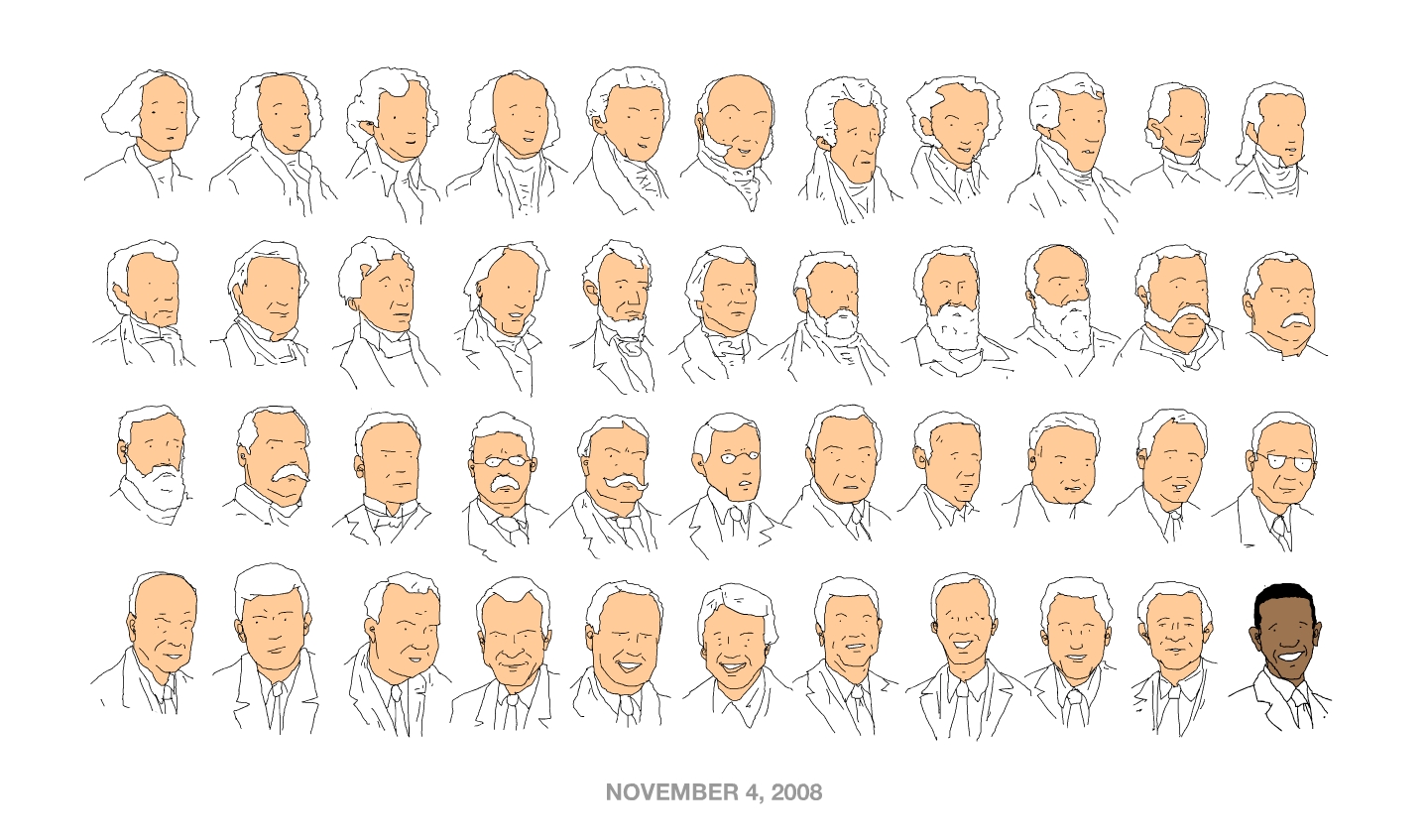
To close, a drawing that's been circulating. I don't want to emphasize the race factor, but it is not something to overlook. Obama will indeed be our first black president, but I would instead like to stress that he is our first non-white president and one of the youngest elected! We have had many excellent leaders in the past, but many have come from similar backgrounds of well-established white upper-class political families (or dynasties). Whereas Obama--with a mother from Kansas and a father from Kenya, born in Hawaii, schooled in Indonesia, educated at Harvard, and working in/with Chicago--not only represents diversity through his skin but through his life story. In many ways, he is the American Dream. We did not elect solely the first black president, but a true American.

Friday, November 7, 2008

Reactions to the Election Abroad

I'm at work, so must keep it short and sweet. Here's an interesting article from an ex-pat living in Wien in response to Obama's election.

Suddenly, it may be cool to be an American again

Tuesday, November 4, 2008

Election Day

It's the big day in America. The first Tuesday of November. The polls are open and the voters are rolling in.

I haven't had the opportunity to express my thoughts about this election here yet, but suffice to say that it has been fascinating. The old methods of campaigning are gone, replacing by campaigning of the internet age. From this idealist's perspective, it seemed that in this election individuals had a say more than ever before. Anyone could start a blog and publish their views, or spread links to YouTube commercials or parodies rapidly through facebook posts. Online ads are everywhere, and even the hip webcomics have endorsed candidates. These individuals have reached the generation of younger voters, the 20-somethings and college students who live daily on the internet. Indeed, over the past few days, over a million facebook users have donated their status to support one candidate or the other.

If you are an American citizen, please get to the polls today. For years we've been slack and little more than half of the American population has exercised their democratic right and privilege. Let's not take it for granted, and let's make our voices heard. Records have registered, and the younger generation is coming out in hordes. Let's make it an election for the history books.

Even Starbucks is making a push by giving out free coffee to anyone who voted.

Disclaimer

The views expressed on these pages are solely belonging to the author and do not reflect the views of the Fulbright Program, the U.S. Department of State or its partner organizations.